The big money is not in the individual fluctuations, but in the main movements. That is, not in reading the tape but in sizing up the entire market and its trend.
Jesse Livermore – 1923
Here we go again. The market opens, and the financial news headlines are singing in chorus: “CrowdStrike’s Latest Global Threat Report Reveals 60% Surge in Nation-State-Backed Attacks!” Immediately, the so-called expert analysts crawl out of the woodwork, chirping about “ever-increasing demand for cybersecurity,” “impenetrable corporate moats,” and “rock-solid subscription revenues.” It’s exhausting 😴. Thousands of retail investors (or as I call them, “sheep”) see this “positive news” and trip over themselves to pile into the stock, terrified of missing out. They believe they’ve been handed some secret insight, when in reality, they’re just reading from a script carefully prepared by Wall Street, unknowingly serving as the “bread crumbs” on a platter for the institutional giants. 🤦♂️ This is the classic herd mentality, a grand theatrical production co-directed by large funds and the media, designed specifically to fleece the retail crowd. They forget the cardinal rule: the news is always the slowest indicator. By the time you read the “facts” in the headlines, the real money has already made its moves on the charts.
Alright, let’s play sheep for a moment and look at the “Official Story” Wall Street wants us to consume.
First, they’ll hit you with some intimidating macro data. According to a forecast by Grand View Research, the global cybersecurity market is projected to reach $538.3 billion by 2030, growing at a compound annual growth rate (CAGR) of 13.4%. Wow, a half-trillion-dollar gold rush! 🤯 They tell you that in a race like this, any horse you bet on is bound to win. Then, they’ll introduce the key players in this “Game of Thrones”:
👑 The Leader: CrowdStrike (CRWD)
Core Advantage: The “Official Story” will tell you that CrowdStrike’s silver bullet is its Falcon platform—a cloud-native, AI-driven architecture. Unlike traditional antivirus software that relies on signature updates, Falcon uses something called the “Threat Graph” to collect and analyze trillions of endpoint events in real-time. In simple terms, if one customer gets hit anywhere in the world, all other customers are instantly immunized. This network effect creates a snowball of defensive capability. They’ll throw data at you: Annual Recurring Revenue (ARR) growth exceeding 30%, gross margins near 80%, and a Net Revenue Retention rate consistently above 120%, proving customers not only stay but also buy more.
Achilles’ Heel: But the “Official Story” will also gently brush over its concerns. They’ll mention that CrowdStrike’s valuation has always been astronomical (e.g., a price-to-sales ratio far above the industry average), meaning the market’s lofty growth expectations are already priced in. Any single quarter that slightly misses expectations could trigger a catastrophic stock price collapse. Furthermore, its business is heavily concentrated in Endpoint Security. While it’s actively expanding into cloud security, identity protection, and other areas, it constantly faces competition from platform giants like Palo Alto Networks, making the risk of a single-point-of-failure ever-present.
⚔️ The Challenger: SentinelOne (S)
Core Advantage: Wall Street will package SentinelOne as the cooler, more automated “next wave.” Their Singularity platform boasts “autonomous” defense, claiming the entire process from detection and investigation to response requires zero human intervention. They’ll argue that in an era of extreme shortages of cybersecurity experts, SentinelOne’s “one-click-and-done” solution is fatally attractive to small and medium-sized businesses. Its growth rate, at times, has even outpaced CrowdStrike’s, making it the most-watched contender in the market.
Achilles’ Heel: The other side of the story is that SentinelOne burns cash as fast as it grows. Its sales and marketing expenses are perpetually high, and it has yet to achieve profitability. It’s a business model of “bleeding for growth.” The market questions whether this story can continue if capital tightens or growth slows. Moreover, its technology is so similar to CrowdStrike’s that its differentiation is blurry, often putting it at a disadvantage when competing for high-end enterprise clients.
🐘 The Incumbent: Palo Alto Networks (PANW)
Core Advantage: When talking about incumbents, you can’t ignore the behemoth, Palo Alto Networks. Their “Official Story” is the “one-stop-shop platform.” From traditional firewalls to cloud security (Prisma Cloud) and security operations (Cortex), PANW covers nearly every security domain a business needs. Their strengths are their brand, distribution channels, and massive customer base. For many corporate CIOs, handing all their security contracts to a single vendor simplifies management and reduces procurement costs, making it the “safe” choice.
Achilles’ Heel: But its size is also its curse. PANW built its platform empire through relentless acquisitions, leading to significant challenges in integrating disparate products and a less-than-seamless user experience. Critics say it’s a “jack of all trades, master of none.” In many specific technologies, like endpoint protection, it simply can’t match the focus and power of CrowdStrike. Its transformation is like an elephant trying to learn how to breakdance—commendable effort, but still clumsy.
After hearing this “Official Story,” do you feel like an industry expert? Do you feel your investment decisions are now well-founded? Wake up. This is all information Wall Street wants you to know. It’s all history.
The Critical Twist: The Chart is the Only Truth
But does any of this actually matter?
The moment you start getting excited about CrowdStrike’s high growth, worrying about SentinelOne’s cash burn, or fretting over Palo Alto’s integration issues, you’ve fallen into the fundamental analysis trap. All of this so-called “analysis” is based on past financial statements and future “projections.” It’s like driving a car while looking only in the rearview mirror. It can tell you what you’ve just passed, but it can never tell you how to navigate the turn up ahead. The research reports and earnings forecasts thrown out by Wall Street are the “bread crumbs” scattered in the forest, designed to lead you, the little sheep, down a predetermined path so they can comfortably offload their shares onto you at the finish line. The real players never drive by looking in the mirror. They look at the map—a real-time map drawn by Price and Volume, showing the true flow of capital.
Let’s run a “thought experiment”:
Scenario A (The Sheep’s Path): On Wednesday evening, CrowdStrike releases a stellar earnings report. ARR is up 35%, blowing past expectations. You wake up the next morning, see the headlines screaming “CRWD Surges 15% After-Hours on Strong Earnings.” You think, “This is it!” and jump in headfirst at the market open. But the stock gaps up and then proceeds to sell off for the rest of the day and the days that follow. You’re left completely bewildered. The news was good, so why is it falling?
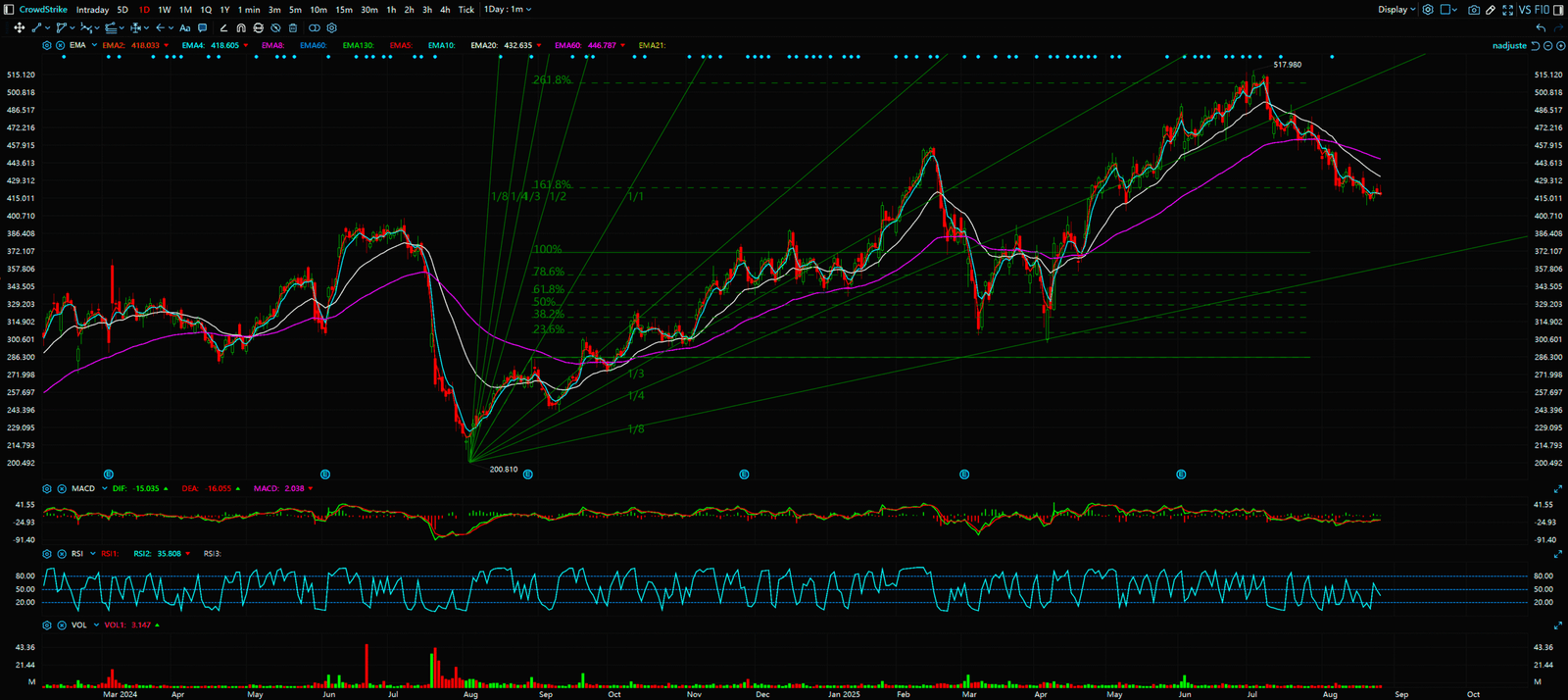
Scenario B (The Navigator’s Path): As a navigator, you noticed CRWD’s daily chart months ago. After a long downtrend, the volume began to expand abnormally, yet the price refused to make new lows—a classic “price-volume divergence.” Subsequently, the stock slowly carved out a rounding bottom pattern and decisively broke above its long-term downtrend line. A few days before the earnings announcement, you saw the price pull back to the neckline support on extremely light volume, a textbook “retest of the breakout.” You entered your position there, with a clearly defined stop-loss. After the earnings, the stock gaps up. You don’t need to chase it; your profits are already soaring. The moment the news hits and all the sheep rush in is the perfect time for you to begin taking profits.
See the difference? The sheep reacts to the “story.” The navigator acts on the “footprints.” Every candlestick, every volume bar on the chart is a footprint left by the big money. Every healthy pullback in an uptrend, every feeble rally in a downtrend, the high-volume shakeouts at the bottom, the high-level churning at the top… it’s all part of the script. The chart is the market’s EKG, telling you whether its mood is greedy or fearful. The chart is the only map for predicting the future, because history always repeats itself, and human nature never changes.
Conclusion: Stop Being the Sheep. Learn to Read the Map.
In the brutal arena of the financial markets, you have only two choices: be a sheep who reads the news, or be a navigator who reads the map. The fate of the sheep is to be perpetually confused by the market’s “Official Story,” chasing highs and selling lows, ultimately ending up as lunch for the wolves. They spend their entire lives asking “why”—why did the stock fall on good news and rise on bad news?
The navigator doesn’t need to ask why. Because we know the chart is the answer. We don’t care if CrowdStrike’s ARR growth is 30% or 35%; we only care if the price is holding above the 200-day moving average. We don’t care when SentinelOne will become profitable; we only care if its stock is forming a higher low. We don’t care if Palo Alto’s integration is going smoothly; we only look to see if volume is confirming its price breakouts.
These are the real rules of the game. This is the knowledge no news channel will teach you, no analyst will tell you. Because if everyone knew how to read the map, who would be left to serve as the bread crumbs?
To seize control of your financial destiny, the only way is to learn this language, to become a navigator who can independently interpret the market’s map. Stop being a pawn. Visit our website, learn the “real rules of the game,” and take back control.
Sources:
Grand View Research – Cybersecurity Market Size & Share Report, 2030