Fetching Live Market Data...
The big money is not in the individual fluctuations, but in the main movements. That is, not in reading the tape but in sizing up the entire market and its trend.
Jesse Livermore – 1923
Another “Groundbreaking Discovery” by the Mainstream Media? 😴 Open any financial news app today, and you’re likely being bombarded by the same headlines: “The Silver Tsunami is Here! Seniors Housing REITs Are the New Darling of Wall Street!” or “Analysts Unanimously Bullish as Welltower Leads Sector Recovery with Strong Occupancy!” 🤯 Every time I see “news” like this, I can’t help but chuckle. This isn’t news; it’s history. It’s the plot summary handed out to the audience after all the actors in Wall Street’s grand play have already taken their positions, ready for the final act of harvesting profits. They package a trend that has been brewing on the charts for months, even a year, into a freshly baked “investment opportunity,” and tragically, thousands upon thousands of “sheep” will buy into it. They believe they’ve received an insider tip to riches, oblivious to the fact that they are merely footing the bill for someone else’s victory banquet. 🤦 These articles will tell you that with the Baby Boomer generation entering their retirement years, the demand for senior housing is set to explode over the next three decades. They’ll quote reports from prestigious institutions, throwing around trillion-dollar market size projections to make you feel like you’re standing at the dawn of a golden era. They’ll meticulously break down the strengths and weaknesses of the leading companies, making you feel like you’ve done your homework and have everything under control. But what they will never tell you is when the truly smart money, the “hunters” of the market, actually entered the game. They won’t show you the map of capital flow—the one and only true and important map: the stock chart. Today, we’re going to rip apart this rosy “Official Story” and see how the charts, in their cold, hard language, reveal the truth that has long since transpired in this industry.
The Fundamental Narrative: The “Official Story” Carefully Prepared for You by Wall Street
Before we unveil the reality, let’s play the part of the “diligent investor” for a moment and listen to the story Wall Street wants us to hear. It’s a compelling narrative, filled with data and authority, enough to entice anyone who relies on fundamental analysis.
The Story’s Backdrop: An Irreversible Golden Opportunity According to the United Nations’ “World Population Prospects 2022,” the global population aged 65 and over is projected to rise from 10% in 2022 to 16% in 2050. In North America, this trend is even more pronounced. A report from Grand View Research indicates that the U.S. assisted living facility market alone was valued at $91.8 billion in 2023 and is expected to expand at a compound annual growth rate (CAGR) of 5.5% through 2030. This translates to a stable, massive, and ever-growing cash-cow market. The core thesis of this story is: people get old, it’s a law of the universe, so investing in services for the elderly is like investing in certainty itself. It sounds foolproof, doesn’t it?
In Wall Street’s script, there are three main characters: the “King,” the “Challenger,” and the “Old Giant” of this golden industry.
👑 The King: Welltower Inc. (WELL)
- Ticker: WELL
- The Official Story: As the world’s largest REIT focused on healthcare infrastructure, Welltower is the undisputed behemoth of the sector. It boasts a massive portfolio spanning the United States, Canada, and the United Kingdom, with properties managed by top-tier operators. Wall Street will tell you that Welltower’s scale is its deepest moat.
- Core Advantage:
- Unmatched Scale & Data Superiority: With over 1,500 properties, Welltower enjoys significant cost advantages in procurement, management, and financing. More importantly, its heavy investment in its proprietary data analytics platform, “Welltower Connected,” allows for real-time monitoring of key metrics like occupancy, pricing, and staffing costs across its portfolio. This enables a level of operational precision that smaller competitors cannot hope to match. For instance, its Q2 2024 earnings report showed a 210-basis-point year-over-year increase in same-store occupancy for its Senior Housing Operating Portfolio (SHOP), reaching 85.7%—a figure hailed by analysts as “irrefutable proof of the sector’s recovery.”
- Premier Partner Network: Welltower doesn’t go it alone. It has forged deep relationships with elite senior housing operators like Atria Senior Living and Sunrise Senior Living. This means it’s not just a landlord but a deeply involved player, ensuring high-quality service at its properties, which in turn supports high occupancy and pricing power.
- Achilles’ Heel:
- High Leverage & Interest Rate Sensitivity: To maintain its vast empire and continuous acquisitions, Welltower carries a significant debt load. In a rising-rate environment, its financing costs increase, directly eating into profits. As of year-end 2024, its net debt-to-adjusted-EBITDA ratio was approximately 5.8x, which, while manageable, is higher than some of its more conservative peers. This weakness is typically downplayed in mainstream reports as “growing pains.”
- Concentrated Operational Risk: While scale is an advantage, it also means that during an economic downturn or a black swan event like the COVID-19 pandemic, its large SHOP portfolio is directly exposed to the risks of declining occupancy and soaring operational costs. Compared to REITs that focus solely on triple-net leases, Welltower’s earnings are inherently more volatile.
⚔️ The Challenger: Ventas, Inc. (VTR)
- Ticker: VTR
- The Official Story: If Welltower is the focused heavyweight champion, Ventas is the agile mixed martial artist. While a major player in senior housing, Ventas strategically diversifies its portfolio with Medical Office Buildings (MOBs), life science research facilities, and university-affiliated innovation centers.
- Core Advantage:
- Diversified Portfolio: This is the most appealing part of the Ventas “script.” When the senior housing market faces headwinds (as it did during the pandemic), the stable rental income from its MOB and life science assets acts as a ballast, steadying the company’s cash flow. Its financial reports show that about 45% of its Net Operating Income (NOI) comes from senior housing, with the other 55% derived from MOBs, life sciences, and other health facilities. This diversification is framed as a “smarter, more resilient” strategy.
- Unique “University Innovation Center” Concept: Ventas partners with top-tier universities like Yale and the University of Pennsylvania to develop research facilities integrated with their campuses. This is portrayed as a visionary strategy, capturing the high growth of the life sciences sector while being backed by the prestige and stability of elite academic institutions, ensuring a high quality of tenants.
- Achilles’ Heel:
- Jack of All Trades, Master of None?: The flip side of diversification is a lack of focus. In the senior housing sector, which demands meticulous operational expertise, Ventas’s management attention is split across various property types. Over the past few years, the performance of its SHOP portfolio, in terms of both occupancy recovery speed and profit margins, has slightly lagged behind the more focused Welltower. This is painfully obvious in its relative chart weakness, but in the mouths of fundamental analysts, it’s merely the short-term pain of a “strategic realignment.”
- Over-reliance on the Life Science Narrative: While life sciences is a high-growth field, it’s also subject to the risks of biotech funding drying up and R&D failures. If that sector enters a down cycle, Ventas’s “growth engine” could stall, leading to a double-hit on its valuation.
🐘 The Old Giant: Healthpeak Properties (PEAK)
- Ticker: PEAK
- The Official Story: Healthpeak was once one of the “Big Three” alongside Welltower and Ventas. In recent years, however, it has chosen a different path, one that is portrayed as a “brilliant transformation.”
- Core Advantage:
- Strategic Pivot to Core Markets: Healthpeak has aggressively divested the majority of its non-core senior housing assets to concentrate all its resources in the top three U.S. life science clusters: South San Francisco, Boston, and San Diego. This story sounds incredibly sexy: shedding the “baggage” of lower-growth assets to embrace a high-tech future. This has resulted in a very clean balance sheet with one of the lowest debt ratios in the industry.
- Extremely High-Quality Assets: What remains is top-shelf. Its life science campuses and the few remaining CCRC (Continuing Care Retirement Community) properties are located in high-barrier-to-entry, high-income areas, giving them strong pricing power and risk resistance. Its Vantage project in South San Francisco, for example, is considered a crown jewel of life science real estate.
- Achilles’ Heel:
- Missed the Seniors Housing Recovery Train: The cost of this transformation has been severe. As the senior housing industry rebounded strongly from its trough over the past two years, Healthpeak, having sold its assets too early, missed out almost entirely on this boom. While Welltower and Ventas were reporting double-digit NOI growth in their senior housing segments, Healthpeak could only watch from the sidelines, holding its relatively slower-growing life science portfolio. It went from being a “giant” of the industry to a “bystander.”
- Great Story, Lackluster Growth: Despite the compelling “focus on life science” narrative, the sector’s growth hasn’t been as explosive as anticipated. Facing headwinds from funding challenges for startup drug companies, the demand for lab space has seen its growth rate slow. PEAK’s stock price has dramatically underperformed the “traditional” Welltower, a fact that stands as the biggest irony to its “brilliant transformation” story.
This script, written by Wall Street, has a grand backdrop, clear characters, and seemingly flawless logic. It lures you into an endless cycle of comparing financial statements, analyzing occupancy rates, and forecasting interest rate movements. You feel like an expert, but in reality, you are just an audience member being led by the nose.
The Critical Turn: But Does Any of This Actually Matter?
Let’s take a deep breath and ask ourselves the most fundamental question: Do the thousands of words of “deep analysis” above—all this discussion of market size, corporate strategy, core advantages, and fatal flaws—truly matter?
No. Not at all. It is all a “rearview mirror.” It is a summary, a rationalization, and a beautification of what has already happened. By the time these reports, news, and analysis articles appear on your screen, the real game is already over. This information is nothing more than the “breadcrumbs” generously sprinkled for the retail crowd by the winners just before they exit the stage. They need liquidity to sell their massive positions, and these beautifully packaged “fundamental stories” are the perfect bait to lure you in. They need someone to hold the bag.
If fundamental analysis were truly effective, why would the top investment banks, which employ the most PhDs in economics and get financial data before anyone else, still spend billions on complex quantitative models and technical analysis teams? The answer is simple: because they know, deep down, that all publicly available fundamental information is obsolete garbage by the time it hits the market price. Price movement reflects the future, not the past. The chart is the one and only “map” that can guide you through the market’s fog. It records the real actions of all market participants—including the whales who possess “insider” knowledge you will never have—in the most honest language possible: price and volume.
Let’s conduct a simple “thought experiment.” Go back to early 2023. At that time, the mainstream media and analysts were still wringing their hands over the “uncertainty” and high operating costs in the senior housing sector. Healthpeak (PEAK) was being praised for its “solid” balance sheet and its “brilliant pivot” to life sciences. Meanwhile, Welltower (WELL) was viewed with suspicion due to its high leverage and “over-concentration” in the supposedly struggling senior housing market. If you were a believer in fundamentals, you would have likely chosen PEAK and avoided WELL.
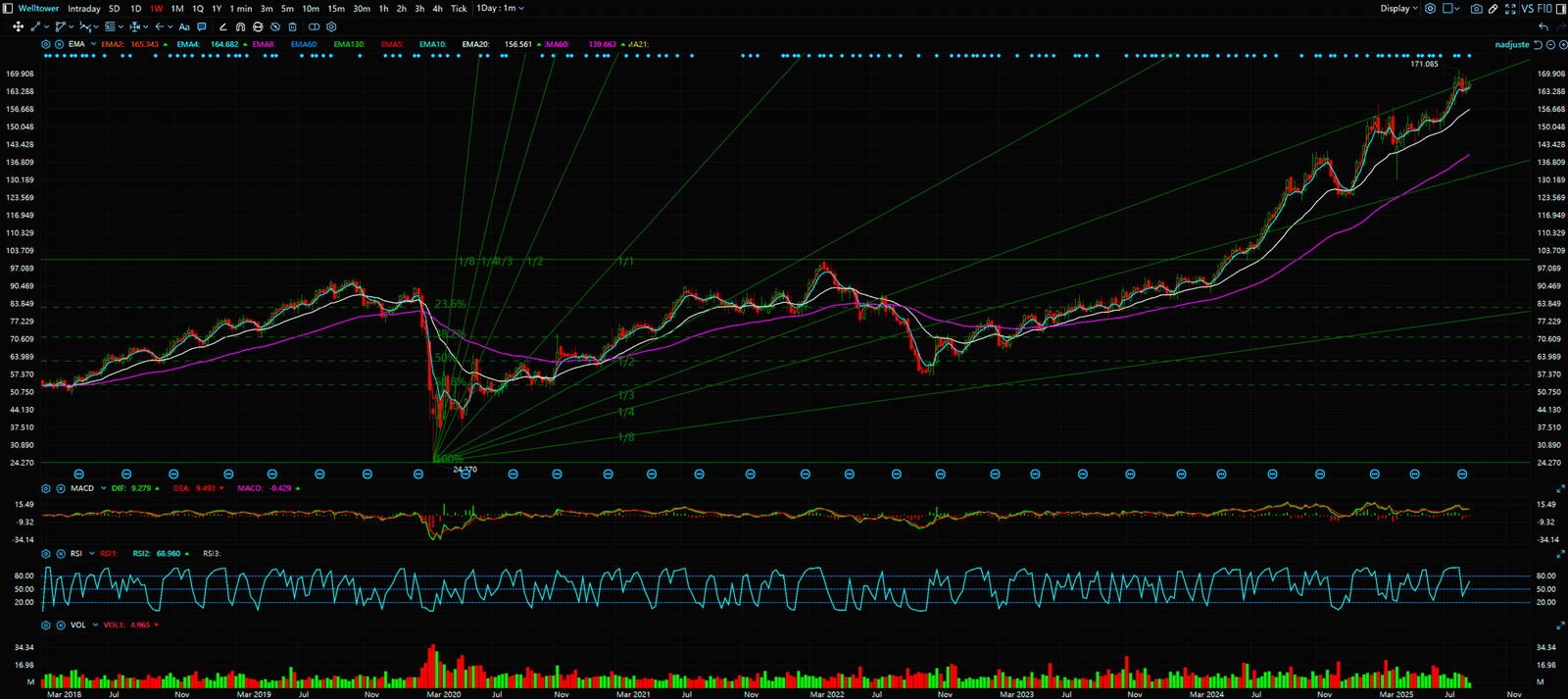
Now, let’s look at the map. What started happening on WELL’s chart in March 2023? First, volume dried up on price declines and gently expanded on price rises—a classic sign of “accumulation” or “collection,” where smart money is quietly entering without wanting to alert the crowd. Then, the price broke above a multi-month downtrend line and firmly established itself above the 50-day moving average. Subsequently, during pullbacks in May and June to test support levels, volume once again contracted, indicating minimal selling pressure. All these signals, like arrows on a map, pointed clearly in one direction: up. And all of this occurred months before the “stellar” earnings reports and occupancy data were widely publicized! Meanwhile, PEAK’s chart showed the exact opposite picture: constantly making new lows, feeble bounces, and volume expanding on declines—the clear footprints of capital fleeing a sinking ship.
The person looking at the “rearview mirror” (fundamentals) would have bought the sinking PEAK. The person reading the “map” (technical analysis) would have boarded the ascending WELL. That is the difference. It is the only difference between winners and losers. The so-called earnings reports and industry analyses are merely excuses concocted after the fact to explain a price move that the chart already predicted.



Conclusion: Choose Your Future—The News-Watching Sheep or the Map-Reading Hunter?
In the brutal jungle of the financial markets, you have only two roles to choose from.
The first is the “news-watching sheep.” You spend your days chasing information fed to you by the mainstream media. You memorize every earnings report. You know the “story” of every company inside and out. You feel smart, informed. But your every buy and sell decision is merely a reaction to a signal set by someone else, long before you. You buy because they need you to buy. You sell because they need you to panic. Your destiny is to be perpetually harvested, chasing highs and selling lows, until your capital becomes the fertilizer for someone else’s wealth.
The second is the “map-reading hunter.” You turn off the noise of financial news. You ignore the fanciful analyst reports. Your one and only faith is in the map drawn by price and volume. You learn to read the “footprints” of capital flow. You learn to recognize the “electrocardiogram” of market psychology. You know that before any “news” is ever released, the truth has already been reflected on the chart. You are no longer a passive recipient of information; you are an active discoverer of reality. You dance with the market whales instead of being their dinner.
Mastering the ability to read a chart is not some mystical gift. It is a learnable, practical skill—the only skill required for survival in this arena. It doesn’t enable you to predict the future; it enables you to follow the present, to follow the money. It is the only pathway to achieving financial freedom in a market saturated with lies and scripts.
Do you want to continue being a docile sheep, waiting for the next shearing? Or are you ready to pick up your map and start learning the real rules of the game? The choice is yours. Visit our website to take the first step toward becoming a hunter.
Sources:
- United Nations, World Population Prospects 2022.
- Grand View Research, “Assisted Living Facility Market Size, Share & Trends Analysis Report”.
- Welltower Inc., Investor Relations, Q2 2024 Supplemental Information.
- Ventas, Inc., Investor Relations, Q2 2024 Earnings Release.
- Healthpeak Properties, Inc., Investor Relations, Q2 2024 Financial Supplement.
Unlocking Technical Analysis: Power Moves with Diagrams
Weekly Timeframe (Welltower)
Weekly Timeframe (Dow Jones Industrial Average Index)
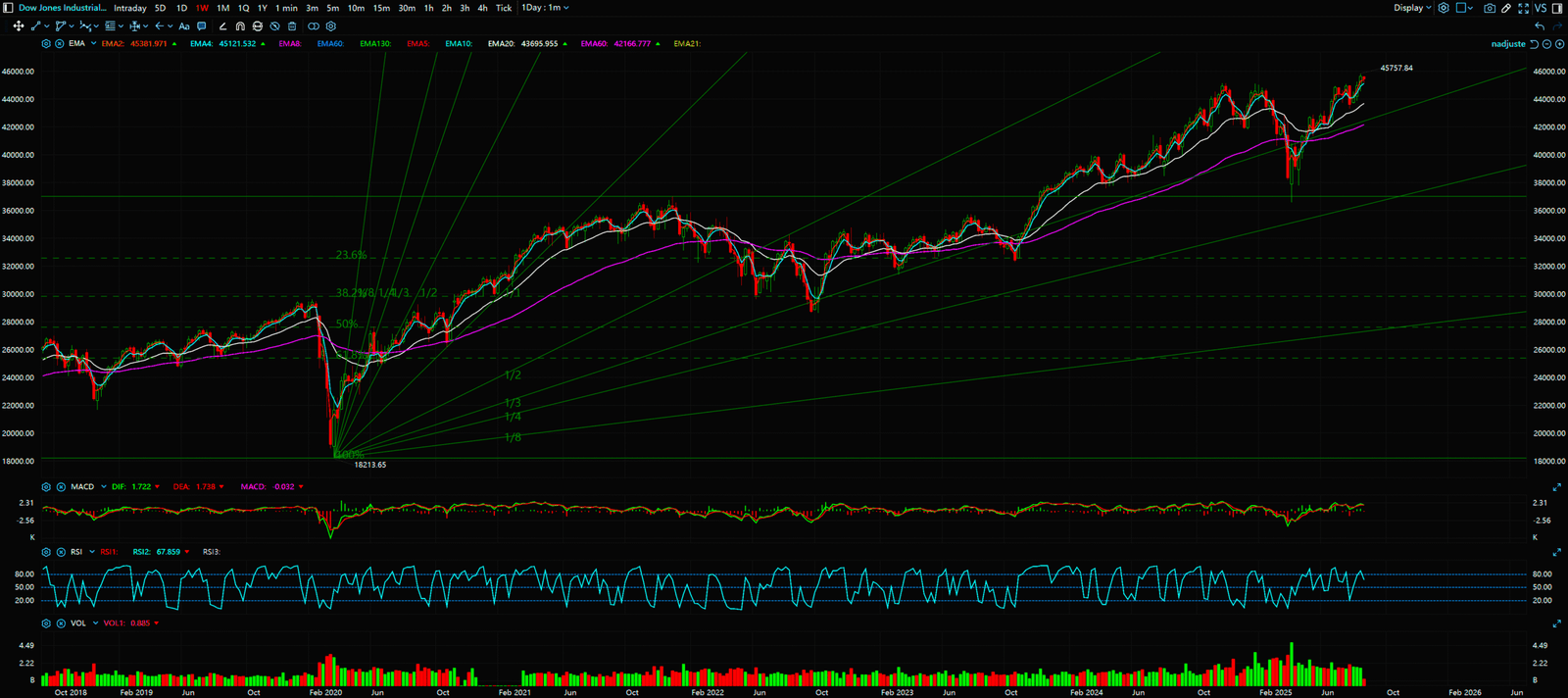
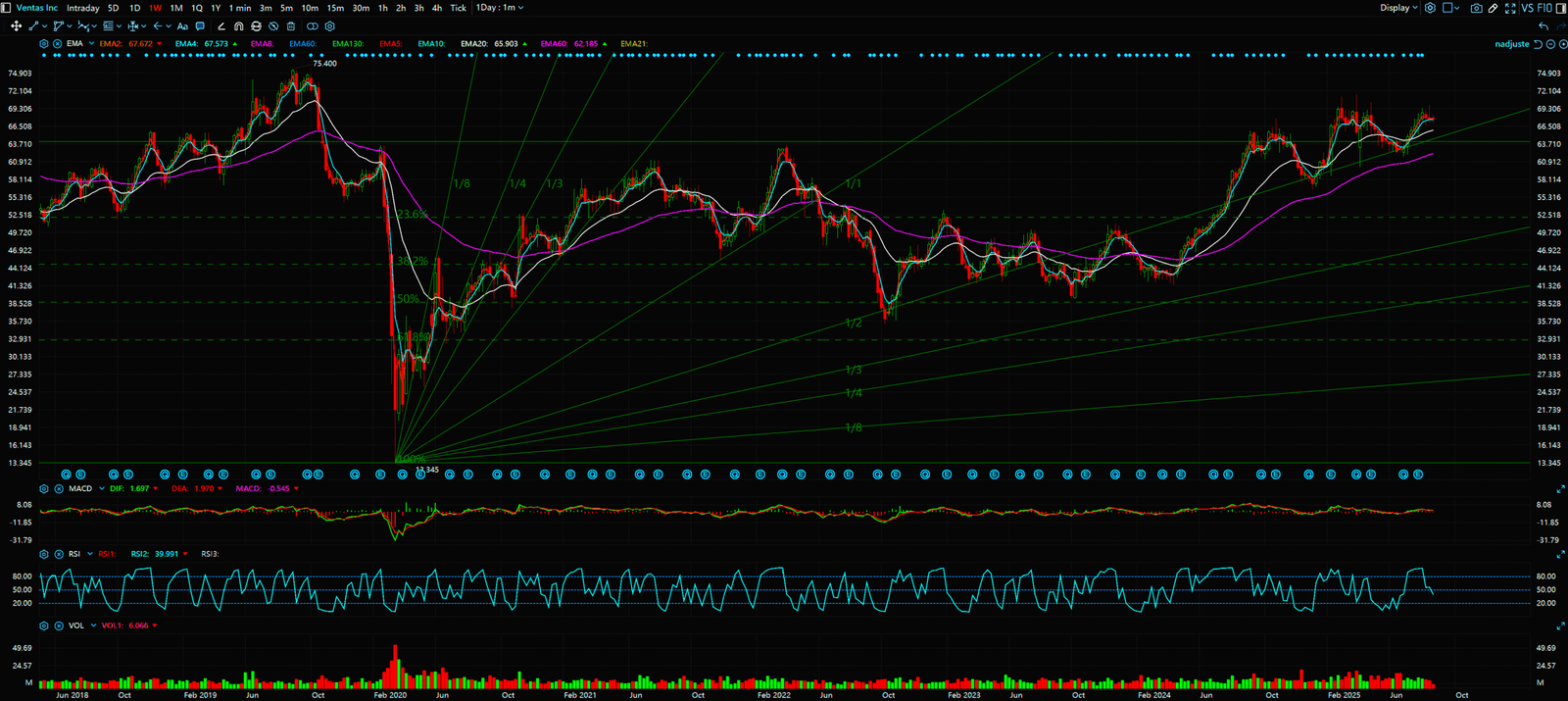
Weekly Timeframe (Ventas)