Fetching Live Market Data...

When you make a trade, you should have a clear target of where you expect to get out
William Delbert Gann – 1949
📰 The most dangerous part of the current Bitcoin market is not the drop below US$80,000 itself. The real danger is that the news flow sounds bullish enough to make retail traders forget where the weekly chart is actually located. Bitcoin has a strong headline package: ETF inflows, resilient options demand, improving institutional participation, stronger network security narratives, and derivative activity returning across major exchanges. But from a former banking-desk perspective, headlines are never the trade. Headlines only explain why the market is paying attention. The chart decides whether that attention is tradable.
CryptoSlate reported that Bitcoin briefly slipped below US$80,000, but options traders did not treat the dip as a structural breakdown. The same article cited CryptoQuant data showing that investors realized profits on 14,600 BTC on May 4, the largest one-day profit-taking event since December 2025. Short-term holder SOPR rose to 1.016 and stayed above 1 from mid-April, suggesting that recent buyers were still selling into profit rather than panic.
At the same time, leverage has returned aggressively. BTC open interest recorded its largest increase of 2026, with Binance accounting for roughly 34% of the derivatives market and Gate.io and Bybit also showing elevated activity. When Bitcoin broke above US$78,600, approximately US$535 million in short positions were liquidated between May 4 and May 6, accelerating the move toward US$82,000–US$83,000. That matters because a short squeeze can create a sharp rally without proving that deep spot demand has returned.
ETF flows add another layer of complexity. Yahoo Finance, citing BeInCrypto, reported that US spot Bitcoin ETFs recorded six straight weeks of net inflows through Friday, attracting a combined US$3.4 billion, the longest positive streak since July 2025. Yet buyers have recently stepped back: the funds saw back-to-back outflows of US$277.50 million on May 7 and US$145.65 million on May 8. In other words, institutional demand exists, but it is not blindly chasing every candle near US$80K.
This is where Chart-Blitz’s core philosophy becomes crucial: fundamental news tells the market what to analyze, but rigorous technical analysis tells traders when and how that story becomes actionable. A retail trader sees “ETF inflows” and thinks breakout. A professional trader sees the same headline and asks whether price has reclaimed resistance, whether volume supports the move, and whether the rally is powered by spot accumulation or leverage liquidation.
【📊Analysis Baseline Statement】
All technical analysis below is based on the locked price snapshot at 2026-05-09 13:49 ET / 2026-05-10 01:49 GMT+8: BTC = US$80,730 USD. Please treat this report as an analytical map, not a live quote. The benchmark is derived from the cross-average of CoinGecko’s US$80,730.14 and CoinMarketCap’s US$80,729.98, with CryptoSlate’s US$80,715.20 widget reading used as a third sanity check..
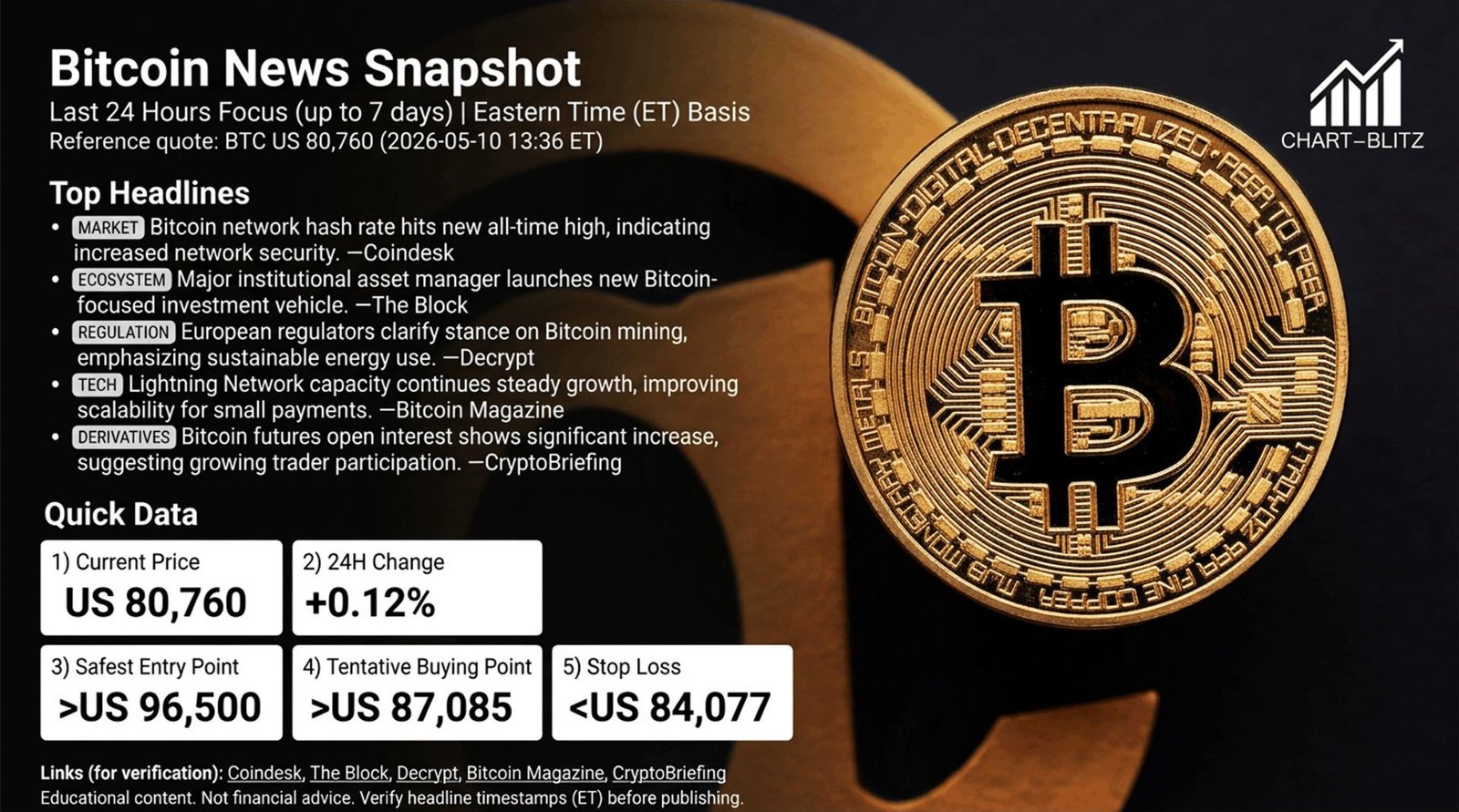
📈Weekly Chart: The Real Battlefield Is US$87,085 and US$96,500
Let’s start with the macro Weekly Chart. Here lies the true code of BTC’s long-term trajectory.
Weekly Timeframe for BTC (Bitcoin)
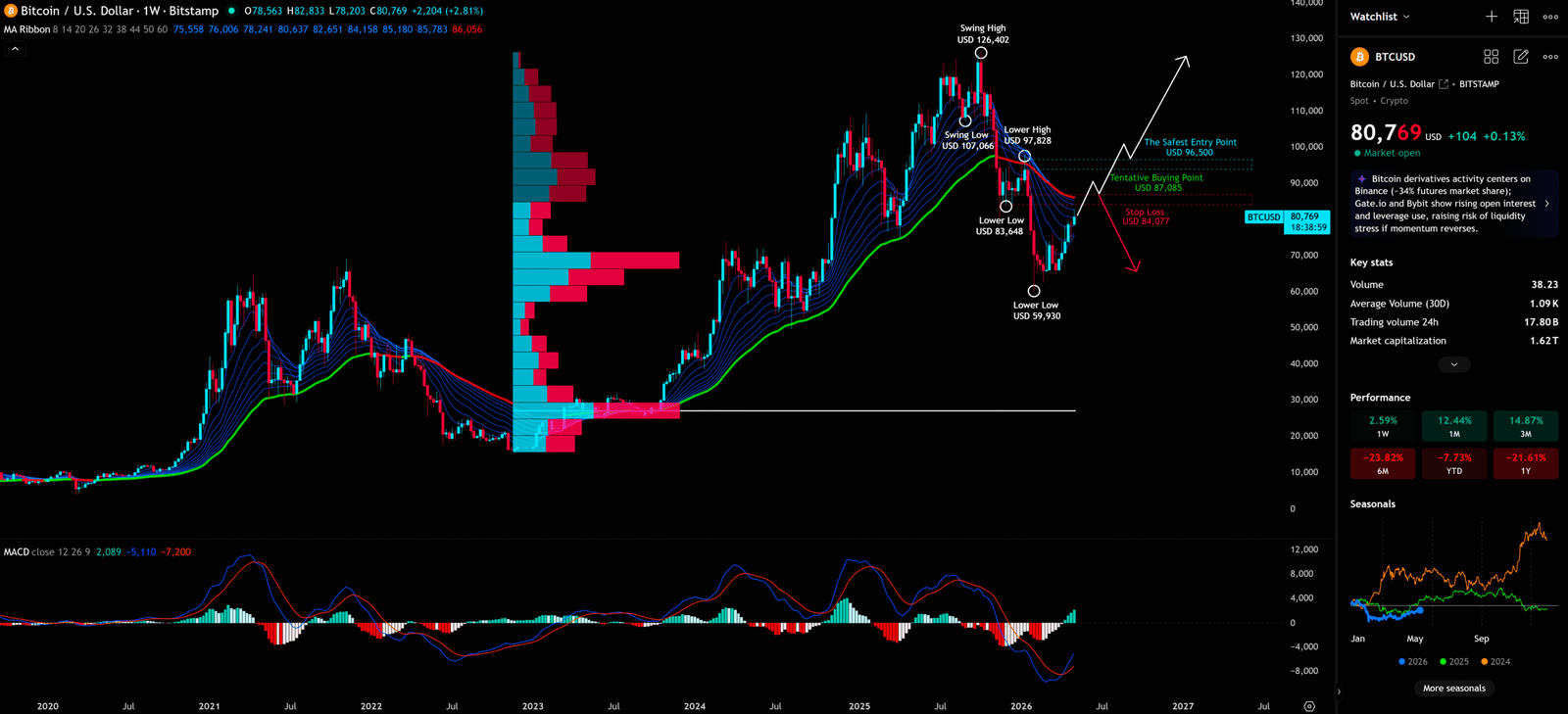
The Weekly Chart must remain the core framework. The user’s weekly BTCUSD Bitstamp chart shows MA Ribbon, VPFR, MACD, and several critical annotations. The swing sequence is not yet a clean bullish continuation. Bitcoin printed a Swing High at US$126,402, then a Swing Low at US$107,066, then a Lower High at US$97,828, followed by a Lower Low at US$83,648, and an even deeper marked Lower Low at US$59,930. Under Dow Theory, a sequence of lower highs and lower lows cannot be dismissed simply because price has bounced back to US$80K.
The Three Trading Levels are the heart of the strategy: Tentative Buying Point = US$87,085, The Safest Entry Point = US$96,500, and Stop Loss = US$84,077. These levels should not be treated as decorative labels. They define the risk architecture. US$87,085 is the first test of strength; US$96,500 is the more reliable confirmation zone; US$84,077 is the point where the bullish breakout assumption must be questioned.
VPFR adds an institutional dimension. Volume Profile Fixed Range helps identify where market participants have exchanged meaningful size. Areas with heavy participation become memory zones; areas with thin participation can behave like vacuum zones, where price travels quickly because there is limited historical liquidity. If bullish news pushes price into a low-volume pocket, institutions may use the resulting excitement as exit liquidity. Retail traders see momentum; professional desks see inventory transfer.
The Weekly MA Ribbon is recovering, but it is not yet in a clean bullish expansion. Price has moved back toward the moving average cluster, while MACD has improved from deeply negative momentum. However, improving momentum is not the same as confirmed reversal. A proper bullish confirmation would require price to reclaim the key resistance band and for MACD to expand positively with structure, not merely rebound from oversold conditions.
The Support/Resistance Flip Rule is the central trading logic: Theoretically, BTC’s decline may not be fully over. However, if BTC refuses to continue lower and instead turns upward aggressively, the key is whether it can rise into the resistance zone, break above it, and hold. If it breaks and holds, entry can be considered; if not, the trade must be exited at the stop-loss zone. In this setup, US$87,085 is the initial resistance flip test, while US$96,500 is the safer confirmation gate.
Elliott Wave must be handled with discipline. If one wants to interpret the correction as a large Wave 4, the iron rule is non-negotiable: the bottom of Wave 4 must never overlap the top of Wave 1. If BTC breaks the critical structural defense and invalidates the five-wave impulse assumption, then the entire 1-2-3-4-5 bullish count may collapse into a larger corrective A-B-C structure. The market does not reward traders for forcing a wave count after price has invalidated it.
A Former Banking-Desk Analogy is useful here. On a professional desk, a trader does not buy because the news terminal flashes “ETF inflow.” The trader checks whether the weekly chart has reclaimed the previous lower high, whether volume confirms the move, and whether the stop level is logically placed. If price rallies into resistance but closes back below it, that is not a breakout; it is a well-lit trapdoor for impatient buyers.



📊Daily Chart: Fibonacci Shows Repair, Not Victory
Zooming into the Daily Chart, the situation becomes clearer.
Daily Timeframe for