Fetching Live Market Data...
When you make a trade, you should have a clear target of where you expect to get out
William Delbert Gann – 1949
While Retail Follows the News, Institutions Have Already Positioned
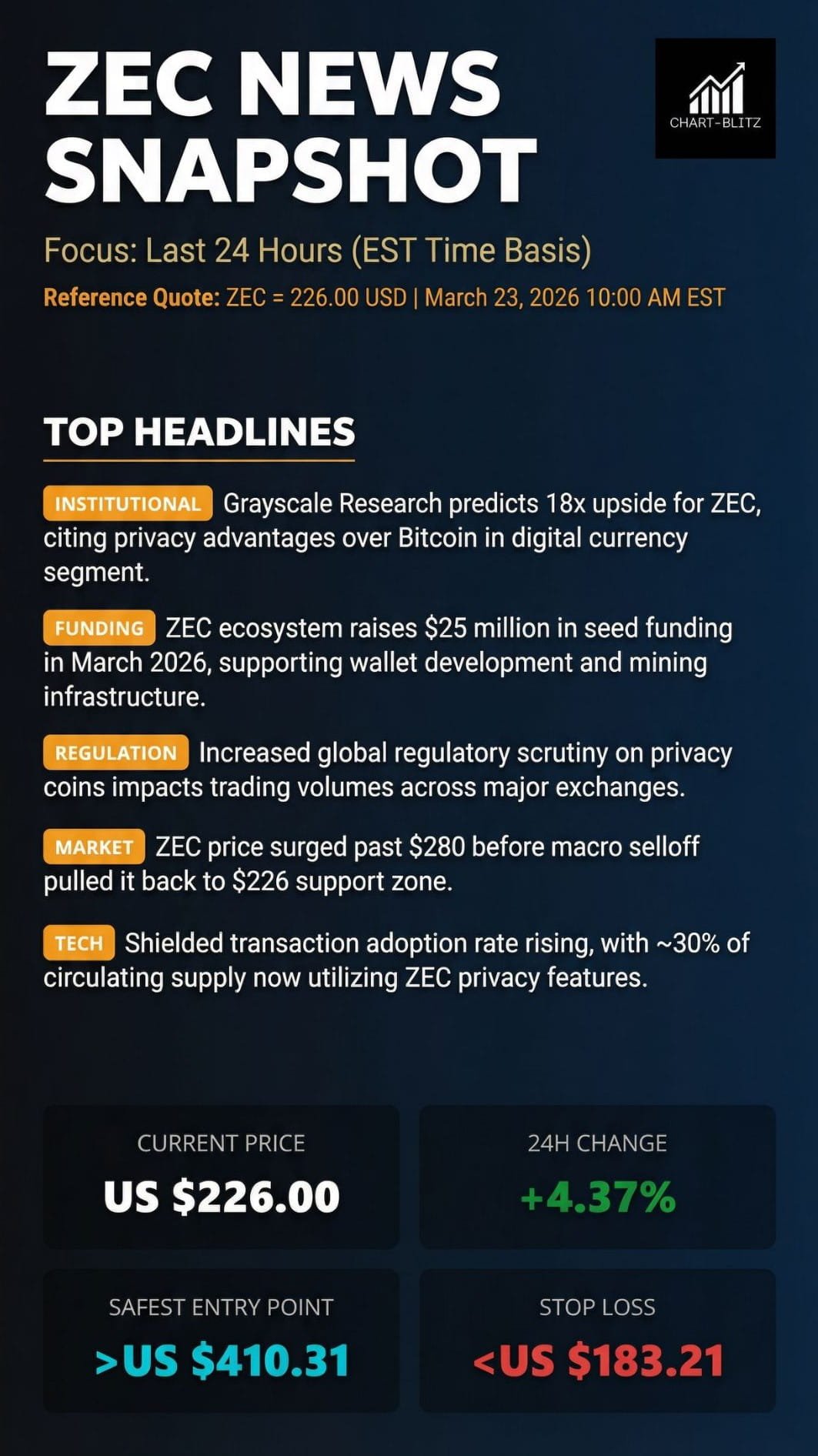
Over the past 24 hours, the cryptocurrency market was ignited by a massive headline. Grayscale’s Head of Research, Zach Pandl, published a research note on March 18th boldly predicting an 18x upside potential for Zcash (ZEC). The core thesis: Bitcoin currently dominates approximately 90% of the “digital currency crypto sector” by market cap, while ZEC represents a mere 0.3%. If ZEC were to capture just 5% of that segment, its valuation would surge 18-fold. Simultaneously, news emerged that the ZEC ecosystem raised $25 million in seed funding in March 2026 to support wallet development and mining infrastructure. The moment this broke, ZEC surged past $280, posting over 23% gains in 24 hours, and market sentiment boiled over.
Retail investors are either lamenting a “missed boat” or panic-selling the dip. Social media is flooded with “ZEC is going to the moon!” hysteria. But as a former trader who spent 20 years on traditional bank dealing floors, I have to tell you a brutal truth you might not want to hear: News is always just a smokescreen released by market makers to complement the chart structure.
Remember Dogecoin in 2021? When Elon Musk’s tweets sent DOGE soaring, retail piled in frantically, but institutions had already built their positions weeks earlier through the technical structure of the charts. Those retail investors who chased the news highs ultimately became the institutions’ “exit liquidity.” Is the ZEC situation today just a replay of the same script? Let’s strip away the sugar-coating of the news and use the most ruthless technical analysis to reveal ZEC’s true hand.
【📊Analysis Baseline Statement】
All technical analysis below is based on a price snapshot locked in at 10:00 AM (EST) on March 23, 2026: ZEC = 226.00 USD (cross-referenced with CoinMarketCap at $227.72 and CoinGecko at $224.35, taking the market average). Please consider this report as an ‘analysis map’ instead of real-time quotes..

📊 Weekly Chart Deep Dive: The Market Maker’s Grand Chessboard and Elliott Wave Code (Core Analysis)
Weekly Timeframe for ZEC (Zcash)
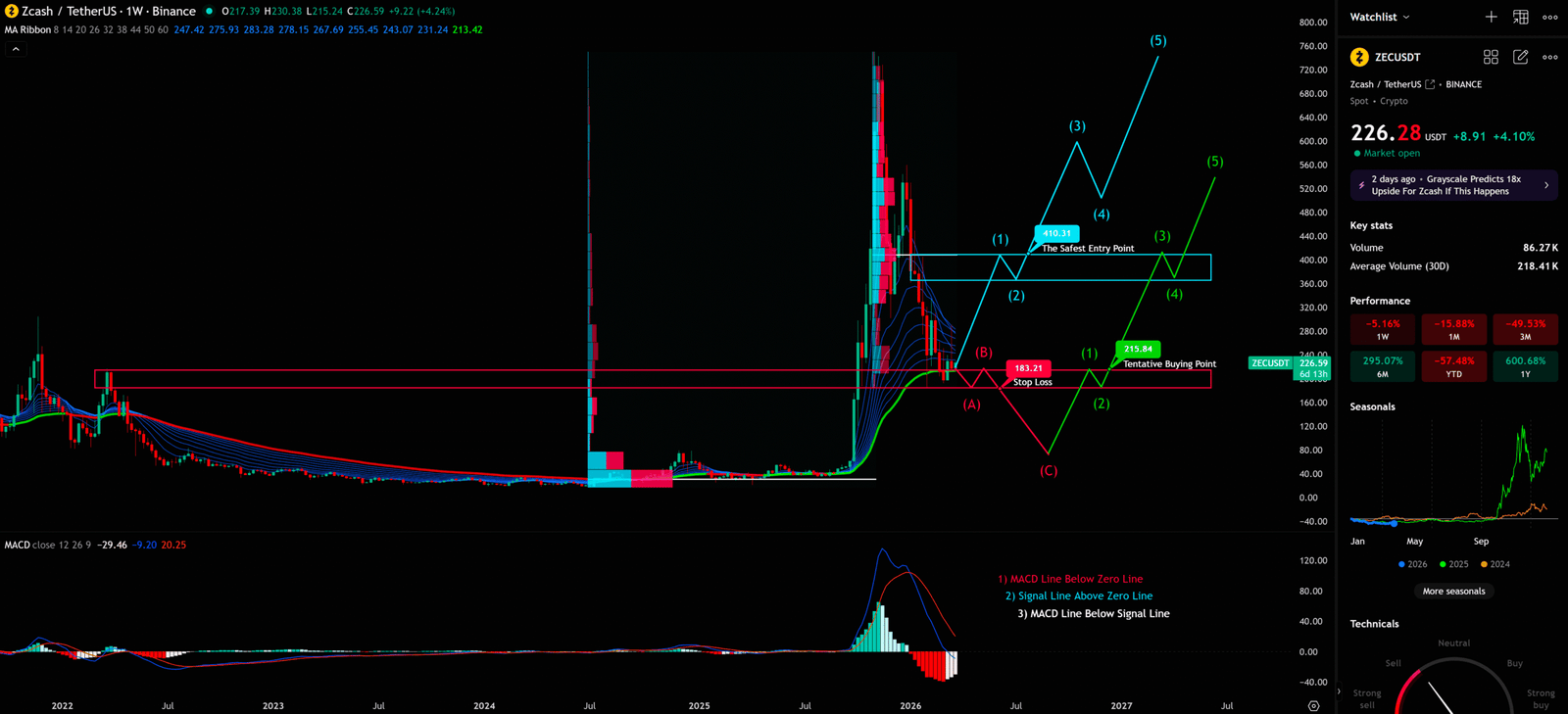
When analyzing crypto, we always start with the big picture. The weekly chart is the ultimate lie detector for institutional money; short-term noise simply cannot hide here. This is why in bank dealing rooms, senior traders always look at the weekly chart first, then the daily, and only then the shorter timeframes.
VPFR Vacuum Zone and Market Maker Positioning
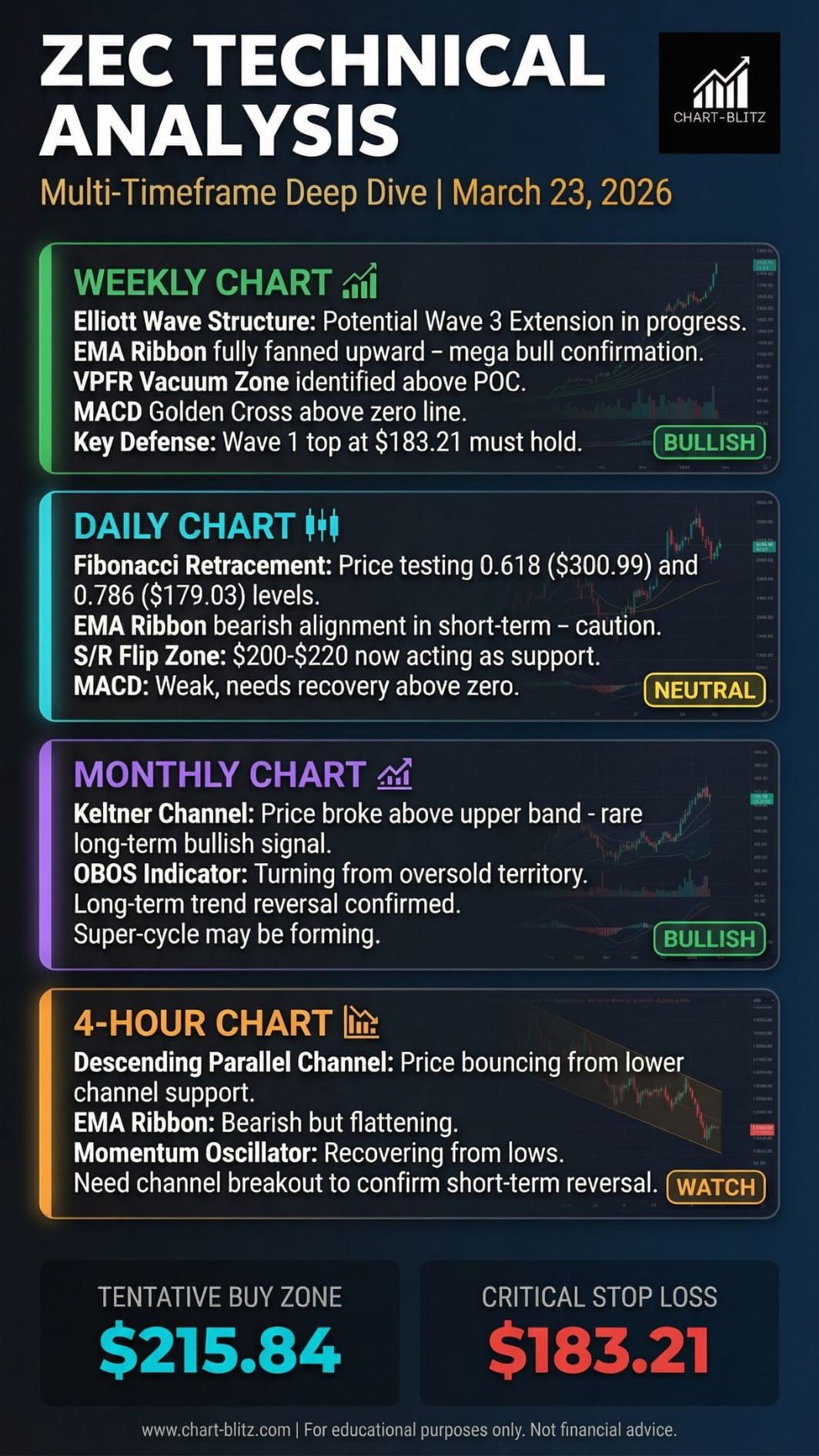
The first thing that catches the eye on ZEC’s weekly chart is the massive VPFR (Volume Profile Fixed Range) indicator on the left. This indicator displays the historical trading volume at different price levels, allowing us to clearly see the “cost distribution” of market participants. The large volume cluster at the bottom of the chart is the POC (Point of Control), the zone of highest historical trading volume. Above the POC, stretching up to the $160-$200 range, there is a glaring “Vacuum Zone” — a price range with almost no historical volume support.
What does this mean? In bank dealing rooms, we call this the “path of least resistance.” When price breaks out of the POC and enters a vacuum zone, it tends to surge at an astonishing speed due to the lack of historical overhead supply. This is the underlying logic behind ZEC’s recent explosive move from around $80 all the way to a high of $780. Grayscale’s report merely provided retail investors with a “story” long after this technical structure had already formed.
EMA Ribbon Bull Market Confirmation
Now look at the EMA Ribbon. This indicator consists of 8 EMAs of different periods, from MA8 to MA60, forming a “rainbow ribbon.” In a bear market, this ribbon fans downward in a “death alignment”; in a bull market, it completely reverses upward, showing a perfect bullish fan-out.
ZEC’s weekly EMA Ribbon has completely reversed upward and is showing a strong bullish alignment. MA8 is at the top, MA60 is at the bottom, and the spacing between the lines is widening, indicating that trend momentum remains strong. This is not just a bull market confirmation; it’s a testament to a powerful mega-trend. Critically, this signal formed months before the Grayscale news broke.
Elliott Wave Theory Deep Interpretation
The user has accurately annotated potential Elliott Wave structures on the weekly chart, which is the most critical part of this entire analysis. Based on the chart annotations, we may currently be in a macro upward motive wave structure.
Elliott Wave Theory tells us that a complete motive wave consists of five sub-waves: Waves 1, 3, and 5 are impulse waves (upward), while Waves 2 and 4 are corrective waves (downward). Based on the chart annotations, ZEC appears to have completed Wave 1’s advance and is currently experiencing Wave 2’s correction, or has already entered Wave 3’s extension.
Elliott Wave Iron Rule (Must Read): When interpreting wave structures, there is one absolute rule that must never be violated: The bottom of Wave 4 must never overlap with the top of Wave 1. On this chart, based on the user’s annotations, the top of Wave 1 is approximately at $183.21. This means that no matter how violent the short-term pullback, as long as the price does not break below $183.21, the entire 1-2-3-4-5 upward motive wave structure remains intact, and we can still expect the subsequent Wave 3 or even Wave 5 to surge strongly.
However, if ZEC breaks below the $183.21 defense line, the entire macro bullish logic will completely collapse. This would mean that the advance we’ve seen may have been just a counter-trend bounce within a larger corrective (A-B-C) wave, rather than the beginning of a genuine new bull market.
MACD Divergence and Breakout
The MACD indicator on the weekly chart has also sent powerful signals. The MACD line (blue) and Signal line (red) formed a golden cross below the zero line long ago and have forcefully broken above it. The expanding histogram validates the sheer power of this motive wave. It’s worth noting that the MACD is now showing signs of high-level divergence, which suggests that short-term correction pressure may emerge and requires close monitoring.
📈 Daily Chart Deep Dive: The Tactical Map for Precision Sniping
Daily Timeframe for ZEC (Zcash)
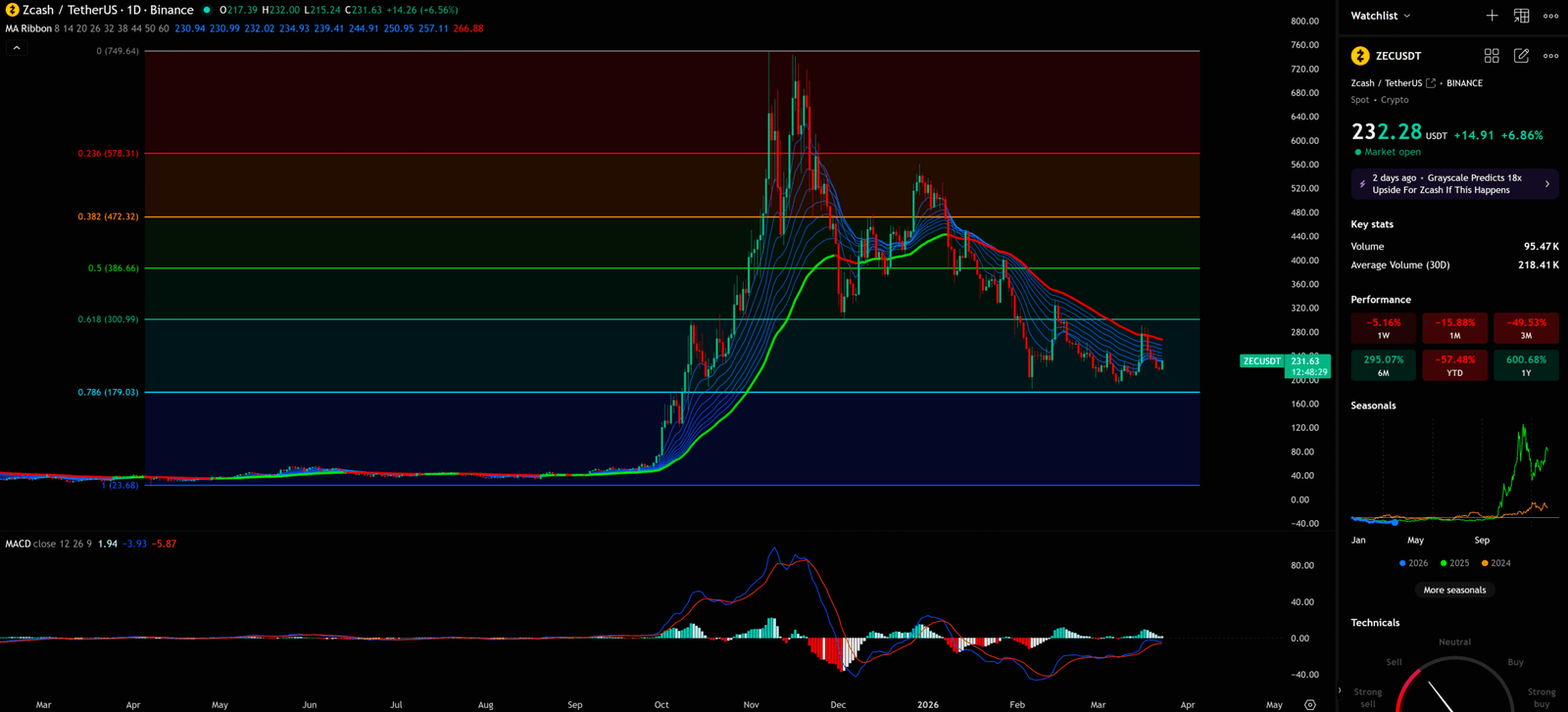
If the weekly chart is strategy, the daily chart is tactics. It tells us where to enter and where to set our stop-loss.
Fibonacci Retracement’s Precise Guidance
On the daily chart, we see a complete Fibonacci Retracement drawn from the bottom to the top. This tool is derived from the golden ratio discovered by the famous mathematician Fibonacci and is one of the most widely used tools in technical analysis. Its core logic: after a strong trend, prices tend to find support or resistance at specific ratio levels before continuing the original trend.
The key Fibonacci levels marked on the chart are as follows:
| Fibonacci Level | Price Level | Significance |
| 0.236 | $578.31 | Shallow pullback support; only strong bull markets hold here |
| 0.382 | $472.32 | Normal pullback support; standard for healthy bull markets |
| 0.5 | $386.66 | Neutral pullback; key battleground for bulls and bears |
| 0.618 | $300.99 | Golden ratio support; deep pullback support |
| 0.786 | $179.03 | Extreme deep pullback; near bottom confirmation zone |
| 1 (Bottom) | $23.68 | Starting point |
ZEC’s current price around $226 is between the 0.618 ($300.99) and 0.786 ($179.03) levels. This zone is a fiercely contested battleground between bulls and bears.
The Core S/R Flip Rule
On the daily chart, we also need to pay special attention to the S/R Flip phenomenon. Previous strong resistance levels (such as the $200-$220 range), after being forcefully broken, have now flipped into strong support levels. This zone is what we call the “S/R Flip Zone.”
Theoretically, the ZEC downtrend should not be over yet, but if the ZEC price does not continue to fall but instead turns upwards and explodes, it needs to be seen whether it can rise to the resistance zone. If it breaks above and holds, then enter the market; otherwise, it will reach the stop loss and sell off.
EMA Ribbon Warning on the Daily Chart
The EMA Ribbon on the daily chart presents a completely different picture from the weekly chart. Currently, the daily EMA Ribbon shows a bearish alignment, with the moving averages fanning downward and the price trading below the ribbon. This is a short-term bearish signal, suggesting caution in the near term.
However, this is not contradictory. The weekly chart’s bullish structure represents the big-picture direction, while the daily chart’s bearish alignment represents a short-term correction. In a mega-bull market, short-term EMA Ribbon bearish alignments are often the best “dip-buying opportunities,” not reasons to turn bearish.
📉 Monthly Chart Deep Dive: The Ultimate Test of Long-Term Conviction
Monthly Timeframe for ZEC (Zcash)
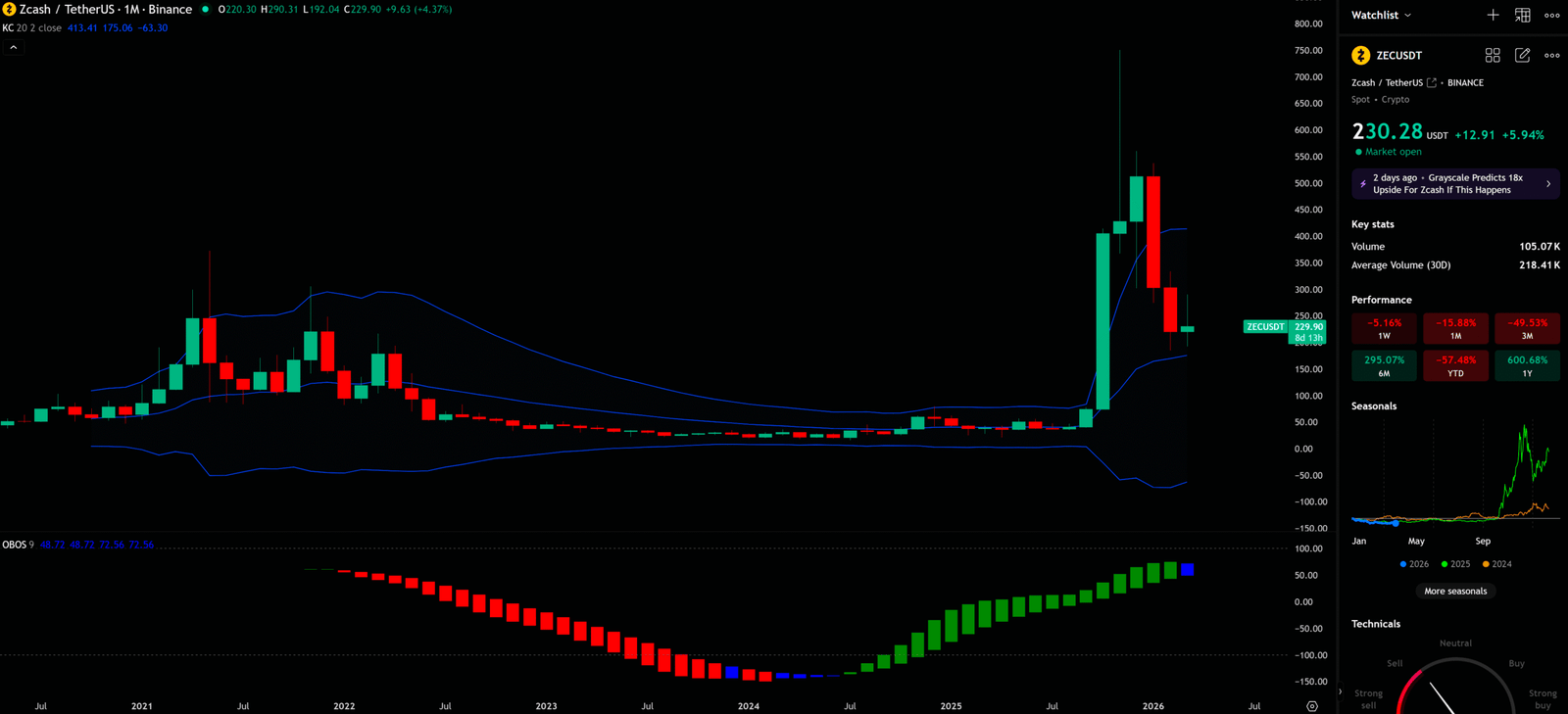
The monthly chart filters out all the noise, leaving only the purest trend. For long-term investors, the monthly chart is the most important reference frame.
The Historical Significance of Breaking the Keltner Channels
On the monthly chart, we see an extremely rare and important signal: ZEC’s monthly candle has forcefully broken out of the upper band of the Keltner Channels with a massive bullish candle.
Keltner Channels were invented by Chester Keltner in the 1960s. They consist of a middle line (usually a 20-period EMA) and upper and lower channel lines, with the channel width determined by ATR (Average True Range). The elegance of this indicator lies in its ability to dynamically reflect market volatility and identify extreme overbought or oversold conditions.
When price breaks out and holds above the upper Keltner Channel band after years of trading in the lower half (as ZEC did during the 2022-2024 bear market), it signifies: First, the long-term downtrend is definitively over; Second, a new super-cycle is brewing; Third, market volatility is significantly expanding, foreshadowing larger price swings ahead.
OBOS Indicator’s Long-Term Inflection
The OBOS (Overbought/Oversold) indicator on the monthly chart remained in deeply oversold territory (negative values) for years, showing that ZEC was severely undervalued during the bear market. Recently, this indicator has strongly rebounded from its bottom and continues to climb into positive territory, indicating that long-term momentum has completely reversed. This resonates perfectly with the monthly Keltner Channel breakout, providing powerful support for the long-term bullish case
📊4-Hour Chart Deep Dive: Short-Term Games within the Parallel Channel
4-Hour Timeframe for ZEC (Zcash)
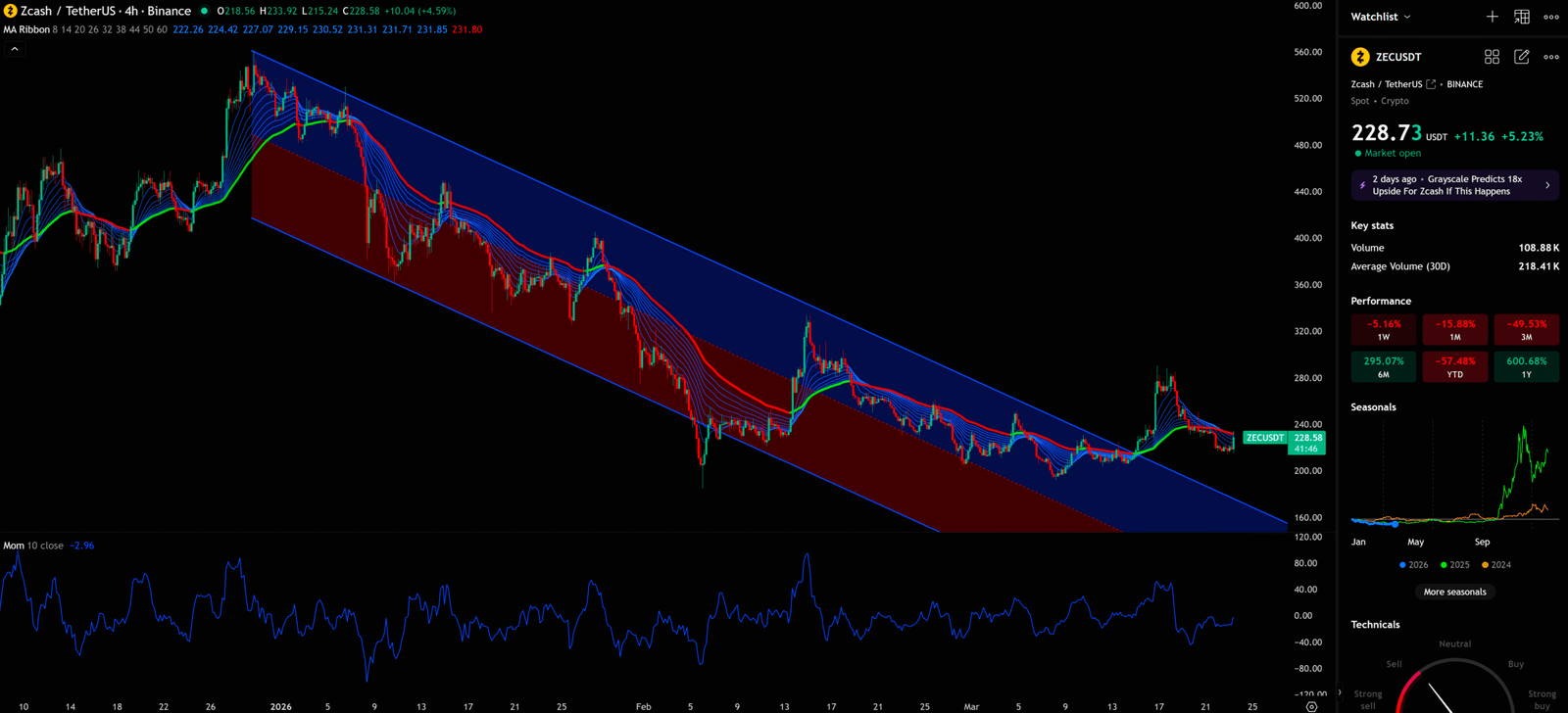
Returning to the present, let’s examine the microstructure on the 4-hour chart. This is the most important timeframe for short-term traders and swing traders.
The Key of the Descending Parallel Channel
ZEC is currently trading within a clearly defined Descending Parallel Channel. This channel consists of two parallel trendlines: the upper boundary acts as resistance, and the lower boundary acts as support. The chart clearly shows ZEC’s price oscillating between the upper and lower boundaries of the channel, exhibiting a classic descending channel pattern.
The recent bounce was triggered exactly after touching the support of the lower channel boundary. This is a short-term technical bounce, not a fundamental change in trend.
To confirm a short-term trend reversal, ZEC must forcefully break out of the upper boundary of this descending channel and flip it into support (another S/R Flip). Until then, any bounce should only be viewed as a corrective oscillation within the channel, and chasing highs carries significant risk.
EMA Ribbon Status on the 4-Hour Chart
The EMA Ribbon on the 4-hour chart currently shows a bearish alignment, but the spacing between the moving averages is narrowing, indicating that downward momentum is weakening. This is a potential bottoming signal, but it’s not advisable to go long aggressively before a confirmed breakout.
Momentum Oscillator Divergence
The Momentum Oscillator on the 4-hour chart shows that while the price has made new lows, the oscillator has not made a corresponding new low, forming a “bullish divergence” pattern. This is a short-term bullish signal, suggesting that downward momentum is exhausting and a bounce may be imminent.
💡Retail vs. Institutions: The Impact of the Information Gap
Let’s do a brutal comparison.
Retail Trader’s Mindset: Sees the Grayscale report, excitedly buys ZEC, entering around $280. Then watches the price pull back to $226 and starts to panic, unsure whether to hold or cut losses. Their decisions are entirely driven by news and emotions, with no systematic analytical framework.
Institutional Mindset: Months earlier, institutional quantitative models had already identified the VPFR vacuum zone and the EMA Ribbon bull market reversal on ZEC’s weekly chart. They quietly accumulated positions in the $80-$100 range, then waited for a “catalyst” to drive retail investors in, providing them with “exit liquidity.” Grayscale’s report was that perfect catalyst. While retail was chasing at $280, institutions were quietly distributing their holdings in batches.
This is why in bank dealing rooms, we have a saying: “News is for retail, charts are for institutions.”
🎯Comprehensive Conclusion & Multi-Scenario Trading Plan
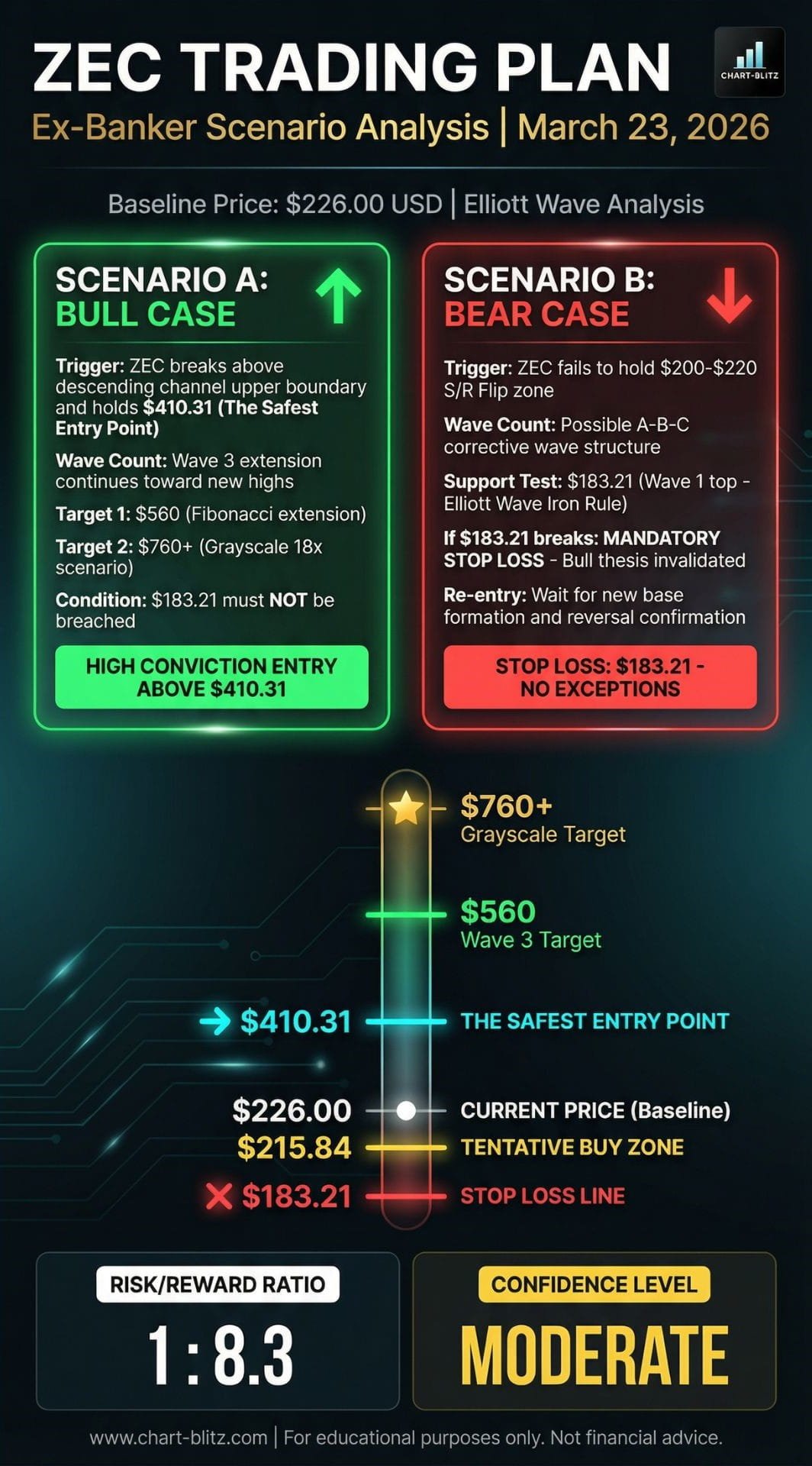
Combining the news catalysts with deep chart analysis across four timeframes, we arrive at the following comprehensive trading plan:
Bullish Scenario — “The Safest Entry Point”
Trigger: ZEC breaks out of the 4-hour descending channel in the short term, recovers the EMA Ribbon on the daily level, and ultimately breaks out and holds above $410.31 (the user-annotated “The Safest Entry Point” on the weekly chart).
The significance of this level is that it was a key resistance level during the previous decline. Once broken and held, it will confirm an S/R Flip, signaling a complete reversal of the macro trend. This is also a high-probability right-side entry point, targeting the previous high of $780 and potentially even higher.
Bearish/Defensive Scenario — “Stop Loss”
Trigger: Macro sentiment continues to deteriorate (e.g., hawkish Fed signals, Middle East geopolitical tensions), ZEC breaks below the current S/R Flip support zone, and tests $215.84 (the user-annotated “Tentative Buying Point”) or lower.
Defense Line: $183.21 (the user-annotated “Stop Loss” on the weekly chart, and the Elliott Wave iron rule defense line). If this level is breached, unconditional stop-loss is mandatory, as it signifies the collapse of the entire macro bullish logic.
Re-entry Strategy After Stop-Loss: If ZEC breaks below $183.21, don’t rush to buy the dip. Wait for the price to form a new base structure at lower levels (such as the $100-$120 range), and observe whether the EMA Ribbon reverses upward again and whether the MACD forms a new golden cross before considering re-entry.
| Scenario | Trigger | Target Price | Stop Loss |
| Bullish | Break and hold above $410.31 | $560 / $760+ | $183.21 |
| Tentative Buy | Hold $215.84 | $300-$410 | $183.21 |
| Bearish/Stop | Break below $183.21 | N/A | Unconditional Exit |
Remember, in the financial markets, surviving is always more important than making big money.
I will continue to closely follow the price action of this crypto. Once I spot a critical reversal signal on the chart, I will update my analysis and views here immediately. Remember to bookmark this page and come back anytime to check the latest updates!
Charts don’t lie, but you have to learn their language.
Want to see our full, interactive chart breakdown? If you want to learn how to draw Fibonacci Retracement Ratio yourself, identify S/R Flips, and stop trading blind. Please browse the following『Further Reading』links. Fundamental news tells you what happened. Technical analysis predicts what will happen. To master the professional framework that separates market signal from noise, explore our exclusive models at www.chart-blitz.com.
📚Further Reading:
- Complete Guide to Fibonacci Retracement — The magical application of Fibonacci sequences in financial markets, and how to combine them with other indicators to improve the accuracy of Fibonacci levels.
- Elliott Wave Theory for Beginners — Learn the counting methods for 1-2-3-4-5 impulse waves and A-B-C corrective waves, as well as the four iron rules of Elliott Wave theory. Master this tool and you’ll be able to see the “roadmap” that retail investors cannot.
- Volume Profile (VPFR) Tutorial — Learn how to use VPFR to identify POC (Point of Control) and “vacuum zones,” thereby predicting market maker layouts and retail liquidity traps.
- S/R Flip Support and Resistance Swap Strategy — S/R Flip is one of the most powerful concepts in technical analysis. This article uses real cases to teach you how to use S/R Flip to capture the highest win-rate trading opportunities.
- MACD Divergence Trading Strategy: How to use MACD divergence to identify trend turning points and position in advance.
- Keltner Channels Breakout for Long-Term Cycles: The secret weapon for identifying long-term super-cycles and capturing once-in-a-decade opportunities.
【Disclaimer】 The content herein is for educational purposes and reflects the author’s personal opinion only; it is not investment advice. All financial investments, including cryptocurrencies, carry significant risk, and you could lose your entire capital. To support this site, this article may contain affiliate links. While we strive for accuracy, we cannot guarantee all information is complete or error-free. Please conduct your own research and be fully responsible for your own investment decisions.