When you make a trade, you should have a clear target of where you expect to get out

William Delbert Gann – 1949

📰 News First: Market Sentiment & Fundamental Catalysts

Over the past 24 hours, news about TRON (TRX) has been overwhelming. The most striking is MetaMask’s announcement of native support for the TRON blockchain, a move that undoubtedly significantly lowers the barrier for Ethereum ecosystem users to enter TRON. Concurrently, TRON DAO, in collaboration with Securitize, hosted a grand “TRON Whale Night” at the Bitcoin 2026 conference, showcasing institutional-grade positioning. Even more astonishingly, data shows a 500% surge in TRON network Crypto Card stablecoin spending, reaching $600 million monthly, with TRON capturing a 35% share of this.

When retail investors see this news, their first reaction is surely: “Wow! All the good news is out, shouldn’t I go all-in and chase it?” FOMO (Fear Of Missing Out) sentiment is instantly ignited. However, as an ex-bank trader who has spent 20 years in the trading room, I must pour cold water on you: News is often just a smokescreen released by whales in tandem with chart movements, aimed at creating “Exit Liquidity.” The real answers are already written on the technical charts.

【📊Analysis Baseline Statement】

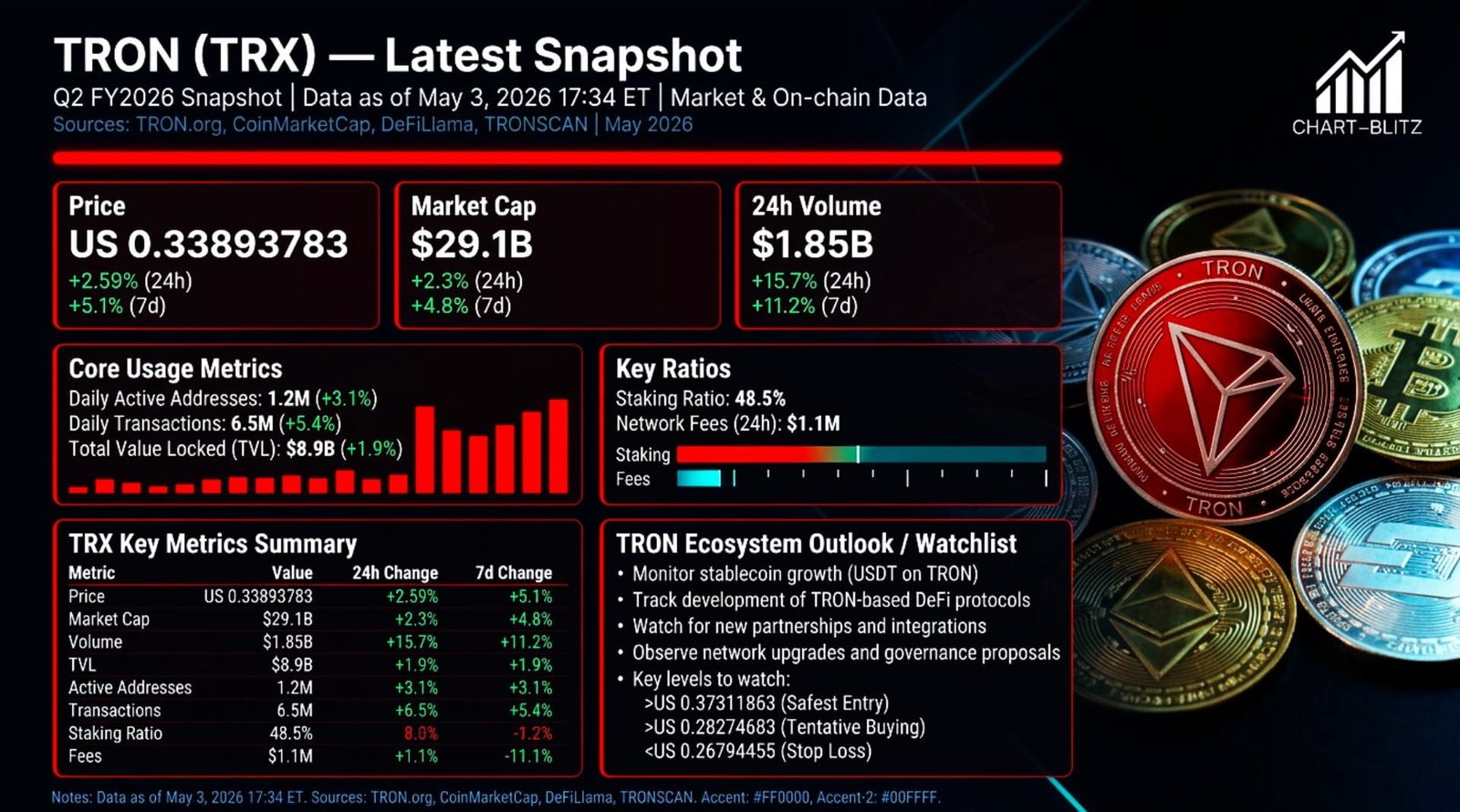
All technical analysis below is based on the price snapshot locked at May 3, 2026 17:34 ET: TRX = 0.3389 USD. Please treat this report as an “analysis map” rather than real-time quotes.
📈Weekly Chart: The Perfect Rendition of Elliott Wave & S/R Flips

Let’s start with the macro Weekly Chart. Here lies the true code of TRON’s long-term trajectory.

Weekly Timeframe for TRX (TRON)
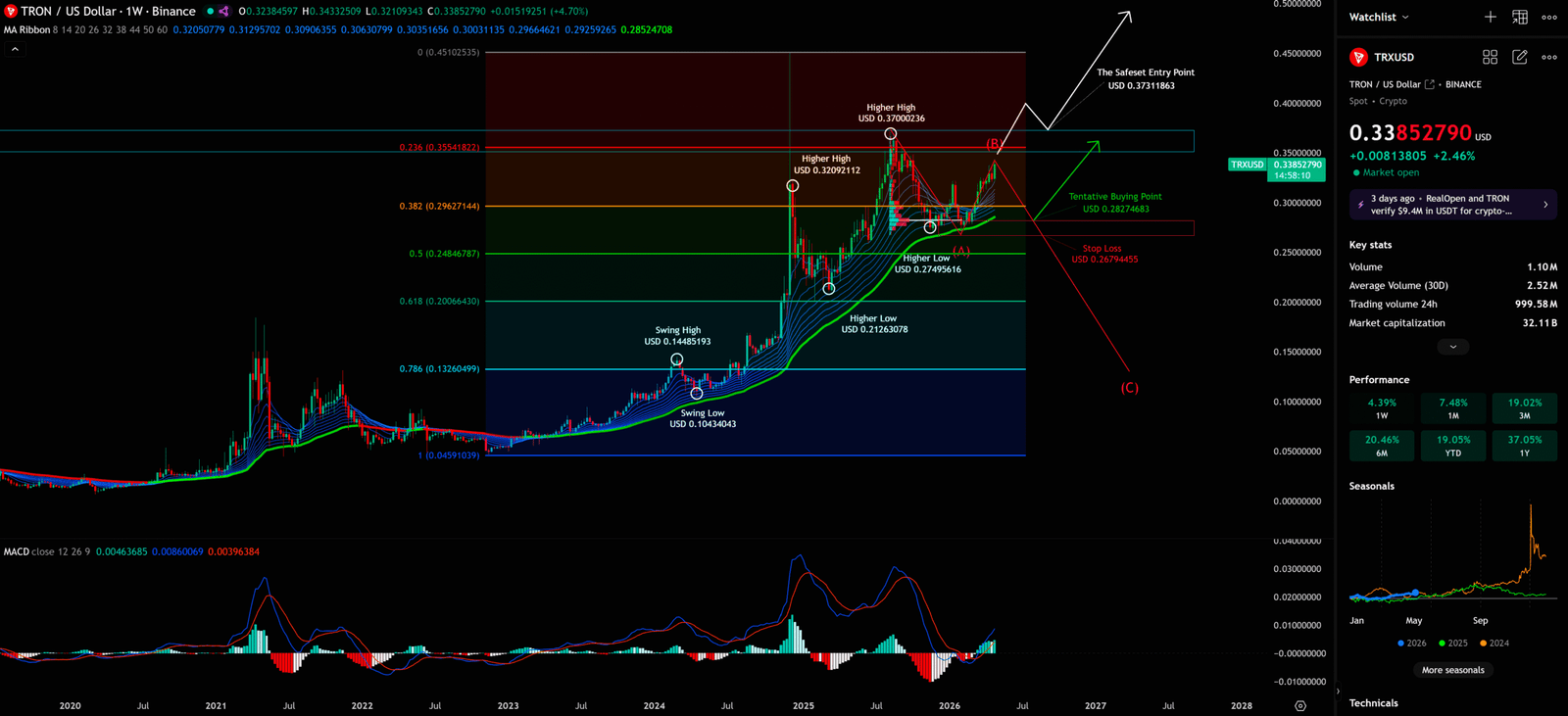
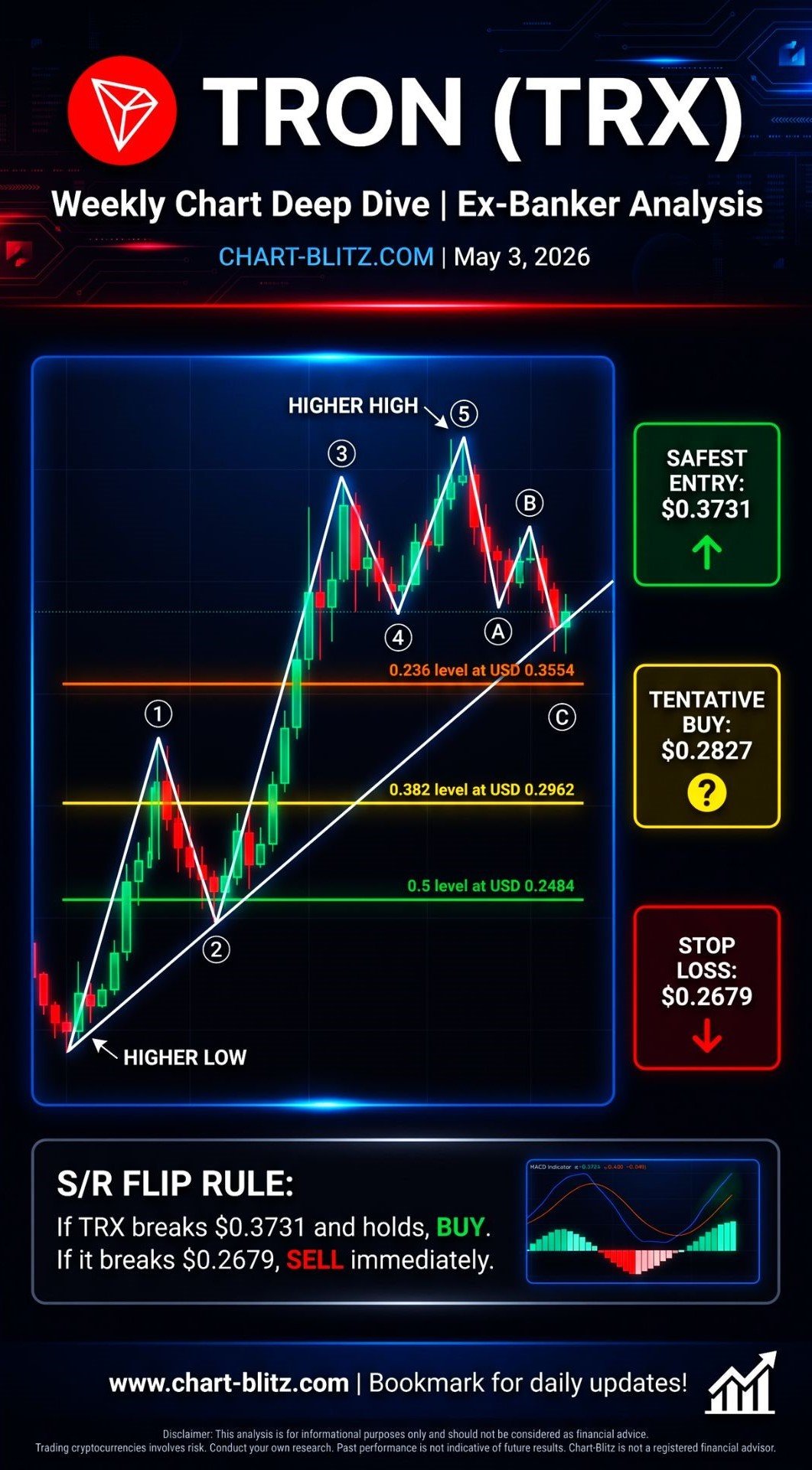
First, looking back at previous movements, from the Swing Low (USD 0.1043) rising to the Swing High (USD 0.1448), then pulling back, and subsequently launching a fierce impulse wave, creating a Higher High (USD 0.3209) and another Higher High (USD 0.3700). This is clearly an impulse wave structure, consistent with Dow Theory’s definition of “Higher Highs & Higher Lows.”

Note the (A), (B), (C) corrective wave projections marked on the chart. The current price is hovering around USD 0.3385, situated exactly within the 0.236 (USD 0.3554) and 0.382 (USD 0.2962) Fibonacci retracement zone. More importantly, there is a very obvious ascending Trendline supporting it from below.

Elliott Wave Iron Rule Warning: If this is a complete 1-2-3-4-5 upward impulse wave, then the current pullback might be wave 4. But remember, the bottom of wave 4 must absolutely not overlap with the price territory of the top of wave 1. If the price breaks below the key defense line, the entire impulse wave hypothesis will be completely shattered, and it might just be part of a larger degree corrective wave (A-B-C).

Three key price levels are marked on the chart:

Key LevelPriceSignificance
Safest Entry PointUSD 0.3731Breaking previous high, confirming trend continuation
Tentative Buying PointUSD 0.2827Tentative buy near trendline and 0.382 Fibo level
Stop LossUSD 0.2679Breaking below indicates extremely high trend reversal risk

Here, we must apply the logic of S/R Flip (Support and Resistance Flip): Theoretically, the downtrend (or pullback) of TRX should not be over yet, but if the TRX price action not only fails to continue falling but instead turns upwards and surges massively, we need to see if it can break the upward resistance zone (USD 0.3731). If it breaks up and stabilizes, then enter the market; conversely, if it hits the stop loss (USD 0.2679), sell and exit immediately.

Additionally, although the MACD indicator is currently still above the zero line, the Histogram shows weakening momentum, implying that there might still be oscillation or downward pressure in the short term. The EMA Ribbon on the weekly chart still maintains a bullish alignment, which is an important indicator of long-term trend health
📊Daily Chart: The Game of EMA Ribbon & Parallel Channels

Zooming into the Daily Chart, the situation becomes clearer.

Daily Timeframe for TRX (TRON)
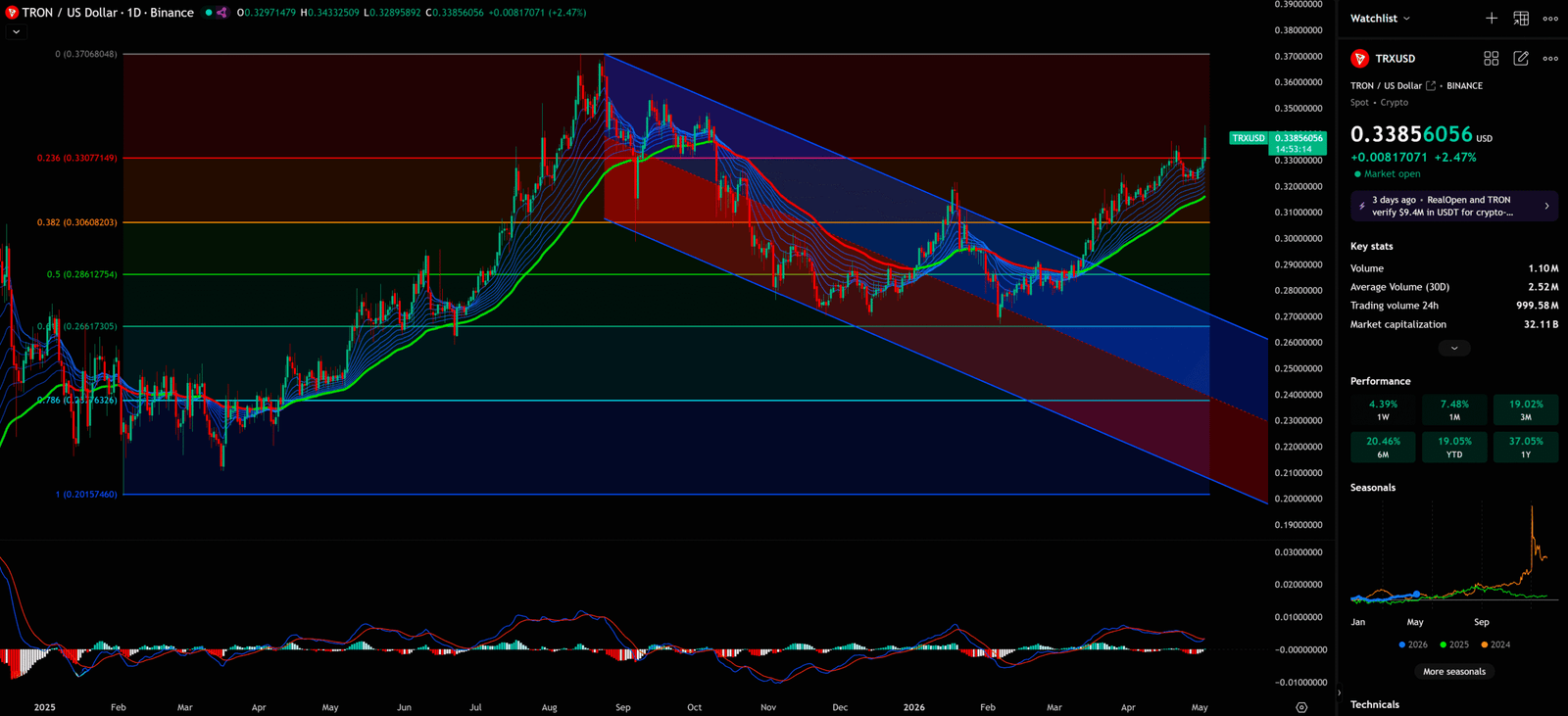
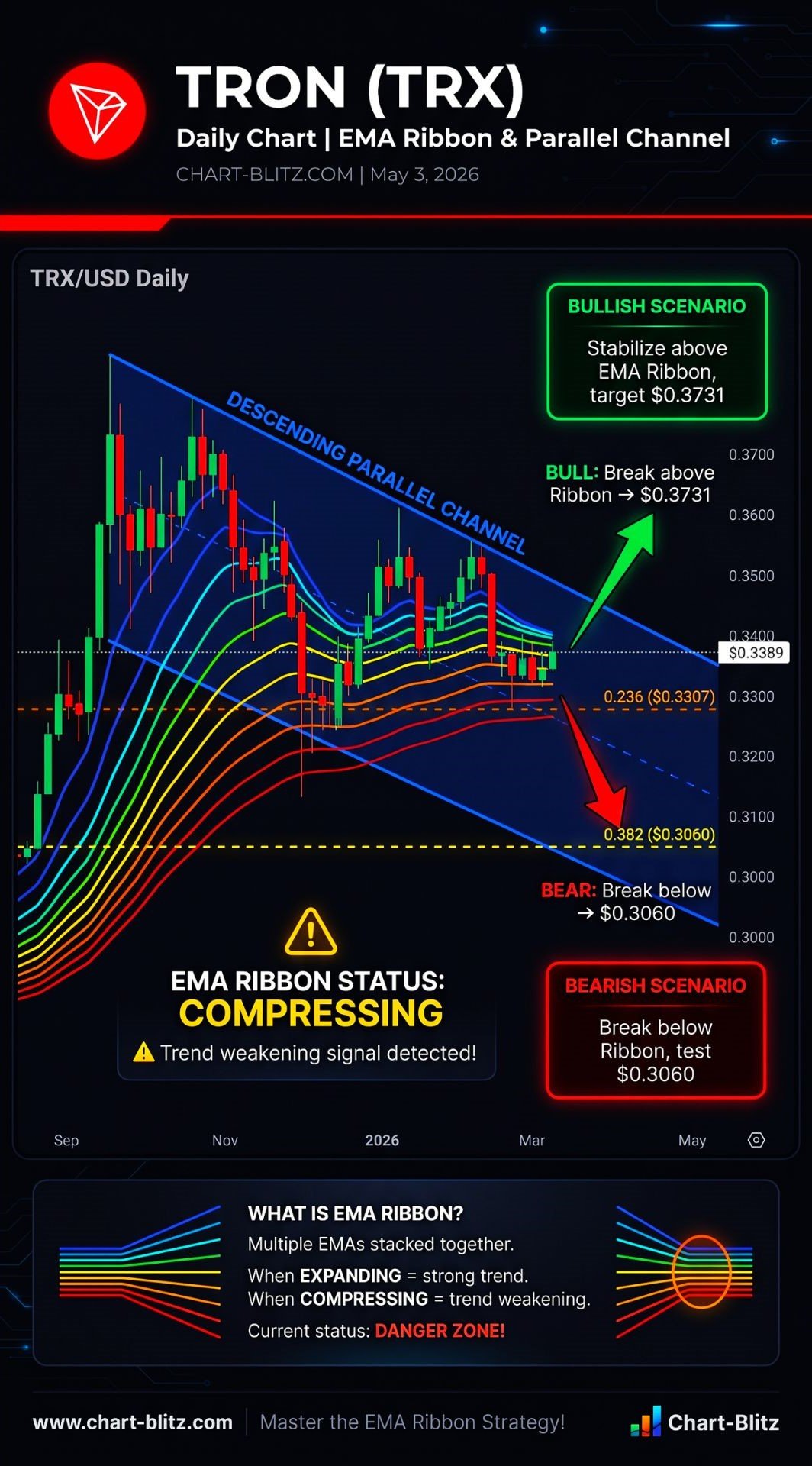
The most eye-catching is that massive Descending Parallel Channel. The price previously hit the top of the channel (around USD 0.37) and met resistance, falling back, and is currently near the midline of the channel. The existence of this channel is a true reflection of short-term market sentiment and an important clue to whale control.

Simultaneously, observe the state of the EMA Ribbon. The Ribbon previously showed a perfect bullish alignment (fanning upwards), but recently the price broke below some short-term EMAs, causing the Ribbon to start compressing and even showing signs of tangling. As mentioned in the EMA Ribbon tutorial, Ribbon compression represents weakening trend, bulls and bears wrestling, market indecision. This is a very important warning signal that cannot be ignored.

If the price can stabilize above the 0.236 Fibo (USD 0.3307) and climb back onto the EMA Ribbon, there is a chance to challenge the channel top again. Conversely, if it breaks below the Ribbon and seeks support at the channel bottom, the next key defense line will be around the 0.382 Fibo (USD 0.3060).

📅Monthly Chart: Bollinger Bands & Long-term Potential

Monthly Chart: Bollinger Bands & Long-term Potential.

Monthly Timeframe for TRX (TRON)

The chart shows that the TRX price is currently above the middle band of the Bollinger Bands, with a tendency to move towards the upper band. The monthly Bollinger Bands are currently in an expansion state, indicating that long-term volatility is increasing, which is usually a prelude to a major move.

More importantly, note the Volume Profile Fixed Range (VPFR) on the right. Between USD 0.20 and USD 0.28, there is a massive volume cluster zone (where the POC is located). This area will provide strong long-term support. In contrast, above the current price, up to near the previous high, the volume is relatively low, forming a “Vacuum Zone”. If the price can break short-term resistance, the upward resistance within the vacuum zone will be smaller, making explosive movements more likely.

However, the KDJ indicator below shows the J line is already at an extremely high position, implying long-term overbought risk and the need to be wary of profit-taking at high levels. The Supertrend indicator on the monthly chart still shows green, indicating the long-term trend is still upward, which is an important bullish signal.

⏱️4-Hour Chart: Short-term Trends & KDJ’s Sensitive Touch

Finally, let’s look at the short-term movements on the 4-Hour Chart.

4-Hour Timeframe for TRX (TRON)

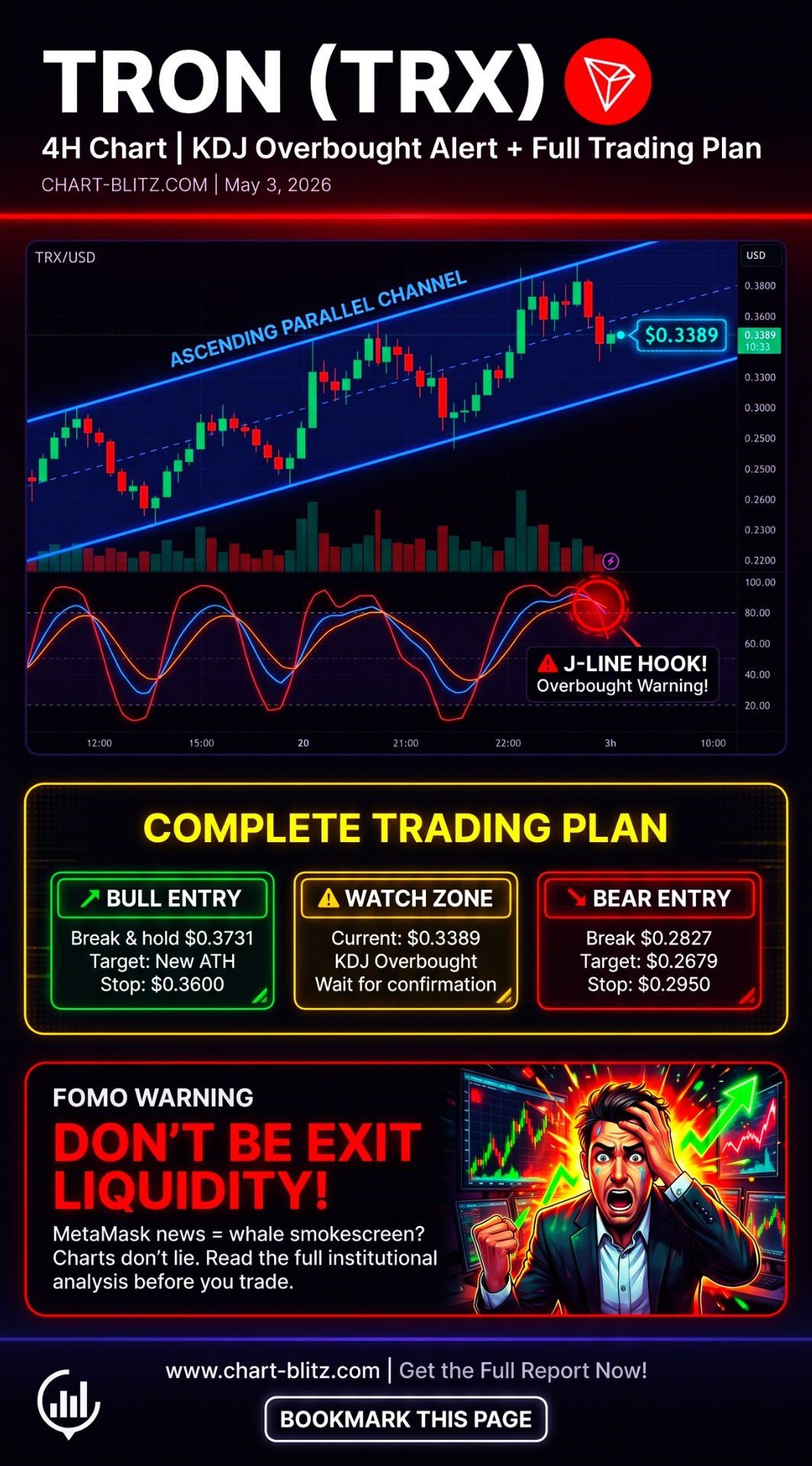
Contrary to the daily chart, the 4-hour chart presents a perfect Ascending Parallel Channel. The price is currently rising steadily along the midline of the channel. The DMI (Directional Movement Index) indicator below shows the +DI (red line) has significantly surpassed the -DI (blue line), and the ADX is also showing an upward trend, confirming the short-term upward momentum.

However, pay special attention to the KDJ Indicator. As an extremely sensitive oscillator, the KDJ’s J line has currently entered the overbought zone and shows signs of hooking downwards. This “hook” pattern might foreshadow short-term pullback pressure to test the support at the bottom of the channel. According to KDJ usage principles, the J line hooking down at a high level is a very noteworthy early reversal warning, although it is not 100% reliable and must be confirmed with other indicators.

💡 Comprehensive Conclusion & Trading Plan (Multi-Scenario Deduction)

Combining fundamental news and multi-timeframe technical analysis, we arrive at the following conclusions:

Whales successfully grabbed a massive amount of retail eyeballs using the bullish news of MetaMask support and surging Crypto Card data. But technical charts tell us that TRX is currently at a critical crossroads.

Scenario A: Bullish Scenario – Breaking the Vacuum Zone

If TRX can digest the short-term overbought pressure, stabilize above the daily EMA Ribbon, and strongly break USD 0.3731 (The Safest Entry Point). Then, coupled with the VPFR vacuum zone on the monthly chart, the price is expected to welcome a new wave of explosive growth.

  • Entry Strategy: Chase the trend after breaking and stabilizing above USD 0.3731.
  • Target Price: Challenge all-time highs.
  • Stop Loss: Below USD 0.3600.

Scenario B: Bearish Scenario – S/R Flip Failure & Deep Pullback

If the pullback triggered by the short-term KDJ overbought condition fails to find support at the bottom of the 4-hour channel, and further breaks below the daily EMA Ribbon and the weekly trendline.

  • Entry Strategy: Consider a light short position if it breaks below USD 0.2827 (Tentative Buying Point).
  • Stop Loss / Reverse Position: The absolute defense line is at USD 0.2679 (Stop Loss). Once broken, it confirms the failure of the impulse wave in Elliott Wave theory, and you must decisively cut losses and exit, or even reverse to short, testing deeper Fibo support levels.

🧠Retail vs. Institutions: The Information Gap That Never Closes

In the wild and greedy cryptocurrency market, there is always a massive information gap between retail investors and institutions.

The retail decision process typically looks like this: See bullish news → Feel FOMO → Rush to enter → Become institutional ‘Exit Liquidity’. The institutional decision process is entirely different: Analyze chart structure → Identify key support/resistance → Wait for S/R Flip confirmation → Quietly exit while retail is FOMOing in.

This is why, every time the market is flooded with overwhelmingly positive news, it is often also the most dangerous time. Because institutions need retail’s buying pressure to absorb their selling, and bullish news is the best bait to attract retail into the market.

In the bank’s trading room, I’ve witnessed this scene too many times: while retail investors were cheering and celebrating, my colleagues were quietly pressing the ‘sell’ button. This isn’t a conspiracy theory — it’s the operating law of the market.

I will continue to closely monitor the price action of this Crypto. As soon as a critical reversal signal appears on the charts, I will update my analysis and insights right here immediately. Remember to Bookmark this page and come back often to check for the latest updates!

Want to see our full, interactive chart breakdown? If you want to learn how to draw Fibonacci Retracement Ratio yourself, identify S/R Flips, and stop trading blind. Please browse the following『Further Reading』links. Fundamental news tells you what happened. Technical analysis predicts what will happen. To master the professional framework that separates market signal from noise, explore our exclusive models at www.chart-blitz.com.

📚Further Reading:

To help everyone gain a deeper understanding of the various technical indicators mentioned in this article, we have specially prepared the following further reading materials. These cover key analytical tools found across the weekly, daily, monthly, and 4-hour charts.

  1. Decoding Fibonacci Retracement: The Perfect Blend of Natural Law and Market Psychology Fibonacci Retracement is not just a set of magical numbers; it is a manifestation of market psychology. Learning how to correctly draw and interpret Fibonacci levels is a required course for every serious trader.
  2. Elliott Wave Theory Practical Manual: Key Rules for Identifying Impulse and Corrective WavesElliott Wave Theory is one of the most complex yet powerful tools in technical analysis. Understanding how to identify impulse and corrective waves, along with the iron rules of Elliott Wave Theory, can help you find direction in the market.
  3. Understanding VPFR: Finding the Hidden Footprints of Market MakersThe Volume Profile Fixed Range (VPFR) is a powerful tool that tells us where the most trading occurred within a specific price range. This helps us identify true support and resistance levels, as well as potential ‘Vacuum Zones’.
  4. S/R Flip Support and Resistance Swap StrategyS/R Flip is one of the most powerful concepts in technical analysis. This article uses real cases to teach you how to use S/R Flip to capture the highest win-rate trading opportunities.
  5. MACD Momentum Indicator Momentum First — What Does the MACD Line Crossing Above Zero Mean? Golden Cross & Divergence Signals!
  6. Catching the Turns: A Quick Guide to the KDJ Indicator — Gain a deeper understanding of the KDJ indicator, which is more sensitive than the Stochastic, and learn how to use extreme values and crossover signals of the J line for short-term operations.
  7. Parallel Channel Short-Term GameHow to Use Parallel Channels to Find Precise Entry/Exit Points for BTC short-term opportunities.
  8. EMA Ribbon Practical Guide: Catching Early Trend SignalsThrough the arrangement of multiple exponential moving averages, the EMA Ribbon intuitively displays the strength and changes of market trends. Learning to interpret the convergence and divergence of the EMA Ribbon allows you to spot trading opportunities ahead of others.
  9. Bollinger Bands Deep Dive: The Prophet of Volatility and Extreme Market ConditionsCombining moving averages and standard deviation, Bollinger Bands are an excellent tool for measuring market volatility. When the price touches the band boundaries, it often foreshadows a potential reversal or breakout.

【Disclaimer】 The content herein is for educational purposes and reflects the author’s personal opinion only; it is not investment advice. All financial investments, including cryptocurrencies, carry significant risk, and you could lose your entire capital. To support this site, this article may contain affiliate links. While we strive for accuracy, we cannot guarantee all information is complete or error-free. Please conduct your own research and be fully responsible for your own investment decisions.

Leave a Reply

Your email address will not be published. Required fields are marked *