Fetching Live Market Data...
When you make a trade, you should have a clear target of where you expect to get out
William Delbert Gann – 1949
The Surface Story Is a Bounce; the Real Story Is a Liquidity Test
Bitcoin’s latest market narrative is almost perfectly designed to trap emotional traders. Price dropped toward $59,500, rebounded toward the $63K-$64K zone, and social media immediately split into two camps. One side declared that the bottom was in; the other warned that the final capitulation had not arrived. Yet the crucial question is not what the crowd feels. The crucial question is what the chart structure is confirming.
CryptoPotato reported that Bitcoin remains under pressure after losing several key support levels, with the breakdown pushing BTC into a major demand region around $60K-$62K. The same analysis noted that BTC still needs to reclaim $66K-$67K before the broader structure begins to improve, while $72K-$74K remains a higher supply zone. That aligns closely with the uploaded charts.
CoinMarketCap Academy added the fundamental layer: Strategy’s sale of just 32 BTC helped trigger a fear narrative, nearly $5 billion in futures liquidations occurred, spot Bitcoin ETFs recorded more than $4.33 billion in outflows, and Mt. Gox transferred 10,422 BTC worth about $739 million on June 2. These headlines matter, but they are not trading instructions. They are the noise that moves retail attention toward areas where institutional liquidity decisions may already be waiting.
In a Bank Trading Room, headlines move the crowd; charts reveal where the crowd is being moved to.
If the news is so bullish, why is BTC still unable to reclaim key resistance? If large players truly want to mark price higher, why is the volume structure not yet confirming a clean regime shift? Could the most dangerous moment be precisely when everyone believes the danger has passed? This report is built around that tension.
【📊Analysis Baseline Statement】
All technical analysis below is based on the price snapshot locked at June 8, 2026, 10:04 PM HKT / 10:04 AM ET: BTC = 63,651.59 USD. This reference price is the average of cross-checked quotes from CoinGecko, Binance BTCUSDT and Coinbase Spot API. At approximately the same time, Binance’s API showed a 24-hour range of roughly $64,234.68 / $61,184.00 and a 24-hour gain of about +2.98%. Treat this report as an analysis map, not a real-time quote.

📈The Weekly Chart Is the Battlefield: $83,061 and $97,922 Matter More Than $64K
The Weekly Chart must dominate the analysis. The market is not defined by one relief bounce; it is defined by the sequence of highs and lows. On the uploaded weekly BTC/USD Bitstamp chart, the user’s annotations show a clear deterioration from a former uptrend into a Dow Theory downtrend.
Weekly Timeframe for BTC (Bitcoin Coin)
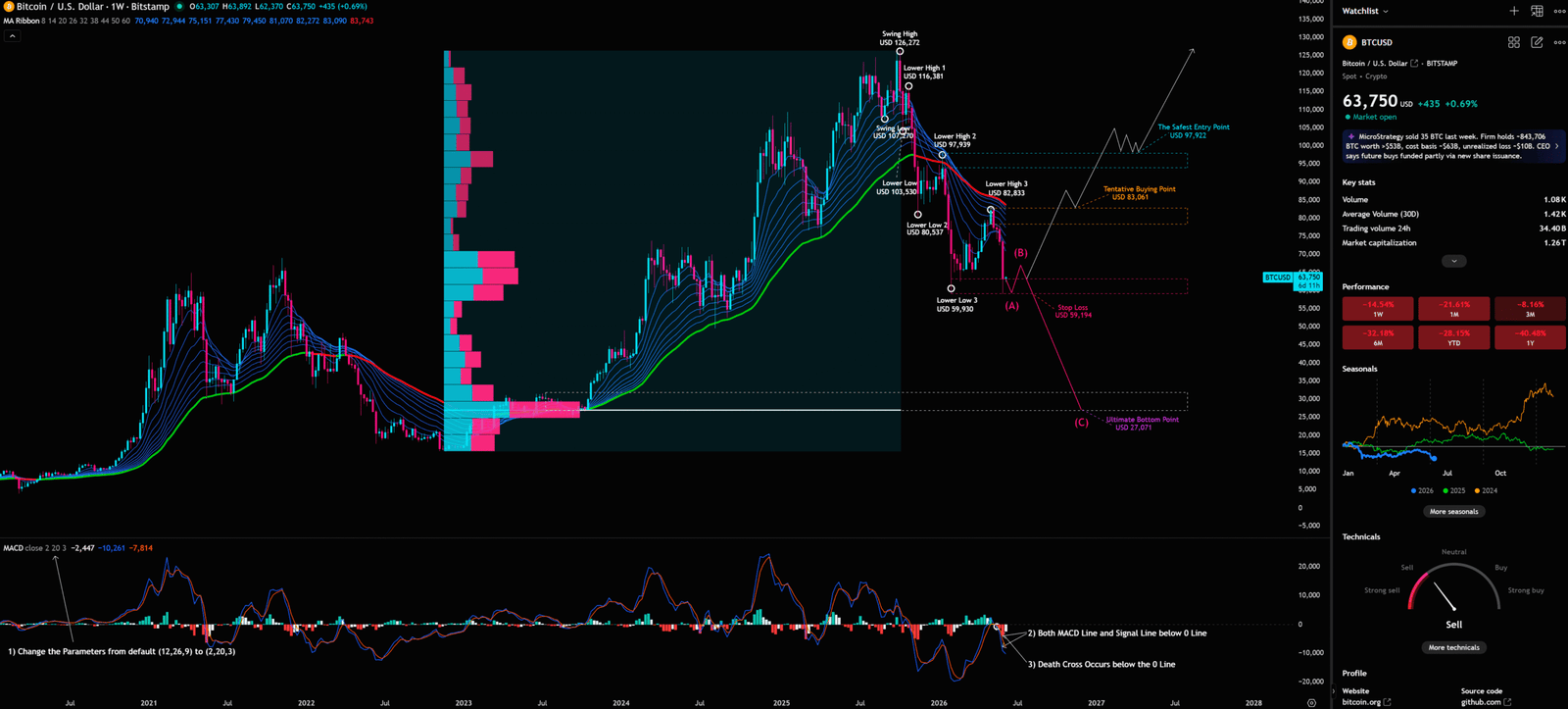
BTC formed a major Swing High at $126,272, then printed Lower High (1) at $115,381. It then slipped through the $107,370 swing low area and marked $101,530 as a lower low. The next rebound failed at Lower High (2): $97,999. Price then broke lower to Lower Low (2): $80,537, rebounded only to Lower High (3): $83,833, and later collapsed toward Lower Low (3): $59,930. This is not random volatility. It is a sequence of failed recoveries and lower acceptance.
The Marked Levels are the core of the trading map. $59,194 is the stop-loss line. $83,061 is the Tentative Buying Point. $97,922 is The Safest Entry Point. The red bearish projection also points to an Ultimate Bottom Point at $27,071. These are not decorative labels; they define where the analysis must be anchored.
Weekly VPFR: The Vacuum Zone Is the Real Risk
The Weekly Chart includes a Volume Profile Fixed Range. VPFR is useful because it does not merely show when volume traded; it shows at which price levels the market accepted volume. In institutional analysis, this often matters more than a moving average, because it identifies where large players have historically been willing to transact.
The Weekly Chart shows the largest visible volume cluster around the high-$20K to low-$30K region, closely aligned with the $27,071 ultimate downside reference. A secondary high-volume region appears around the $50K-$60K zone. Between the current price and the $83K-$98K resistance zones, volume support looks thinner. That creates a Vacuum Zone: price can move quickly through it, but it can also fail sharply if there is no genuine demand behind the bounce.
Retail traders see the bounce from $59K to $64K and assume buyers are in control. Institutions ask a different question: is this long-term accumulation, or short-covering and emotional dip-buying? If price cannot reclaim $83,061, bullish news could become exit liquidity for stronger hands rather than confirmation of a new bull phase.
Weekly MACD: A Death Cross Below Zero Is Not a Small Warning
The Weekly MACD on the chart uses non-default parameters (2,20,3), clearly designed to capture faster medium-term momentum changes. The chart annotation states that both the MACD line and signal line are below the zero line and that a death cross has occurred below zero. That is materially different from a shallow pullback above zero. A death cross below the zero line suggests weakness is occurring inside an already negative momentum regime.
A bank desk would describe this as capital cost withdrawing from the asset. When momentum turns down above zero, traders may still treat it as a pullback. When momentum turns down below zero, the default assumption becomes defensive until structure proves otherwise.
Elliott Wave: Do Not Declare Wave 4 Complete Too Early
If one tries to interpret the decline as a Wave 4 correction within a larger impulse, one rule is non-negotiable: the bottom of Wave 4 must not overlap the top of Wave 1. If the relevant Wave 1 top is violated, the entire 1-2-3-4-5 impulse thesis is invalidated, and the market may instead be forming a larger A-B-C corrective structure.
The Weekly Chart already marks an A-B-C style bearish path. Therefore, the $59K bounce should not be casually labelled as a completed Wave 4 bottom. If the $59,194 stop-loss line and the daily 0.618 level at $57,938 fail, the bearish path toward deeper levels becomes more relevant, not less.


📊Daily Chart: The 0.5 Fibonacci Level at 71,063 USD Is a Psychological Trap Disguised as Support
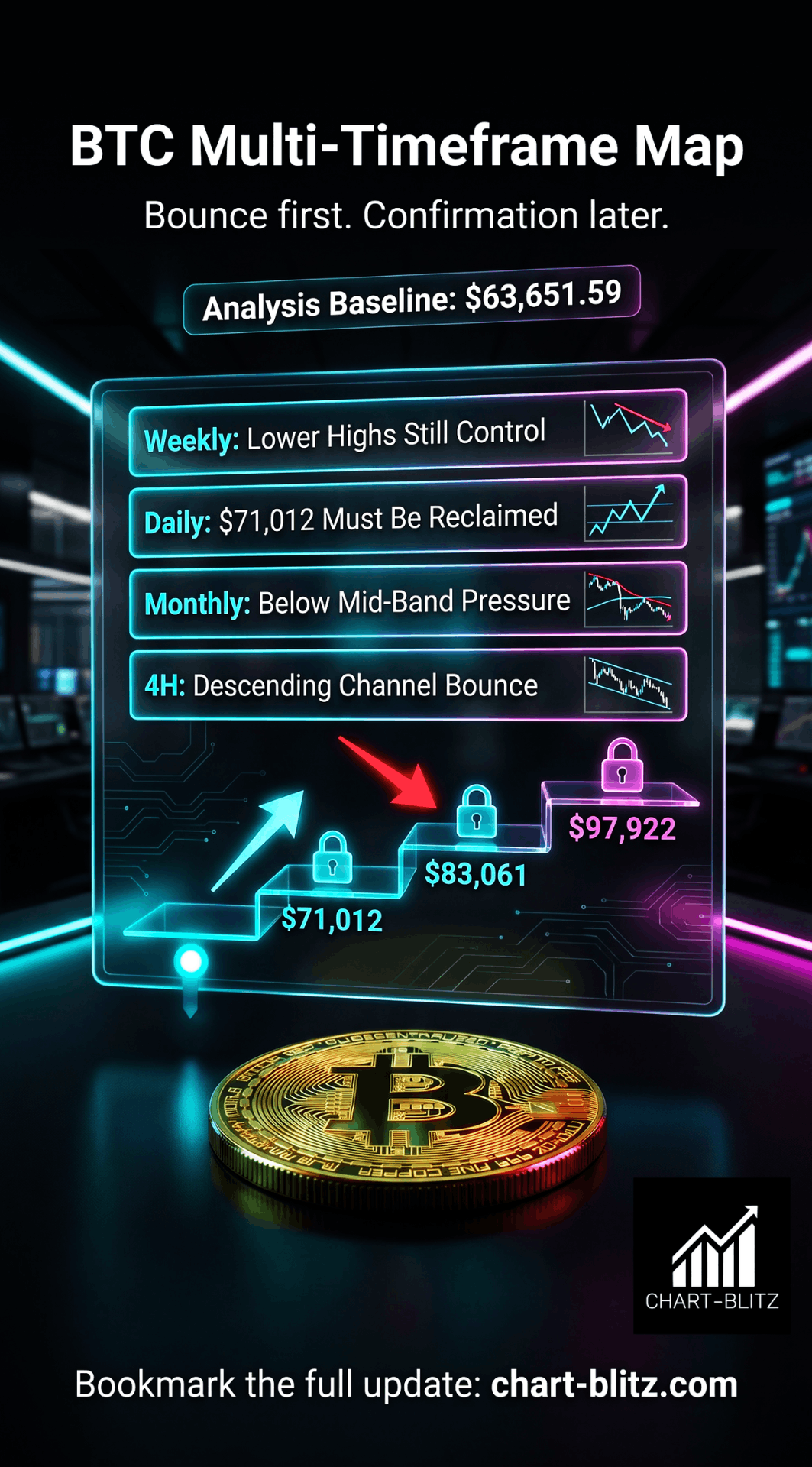
The Daily Chart translates the weekly risk map into tactical levels. The Fibonacci retracement uses the move toward the $126,472 high and marks 0.236 at $100,361, 0.382 at $84,087, 0.5 at $71,012, 0.618 at $57,938, and 0.786 at $39,324. The locked reference price of $63,651.59 sits between the 0.5 and 0.618 levels, closer to the 0.618 support.
Daily Timeframe for