Fetching Live Market Data...
When you make a trade, you should have a clear target of where you expect to get out
William Delbert Gann – 1949
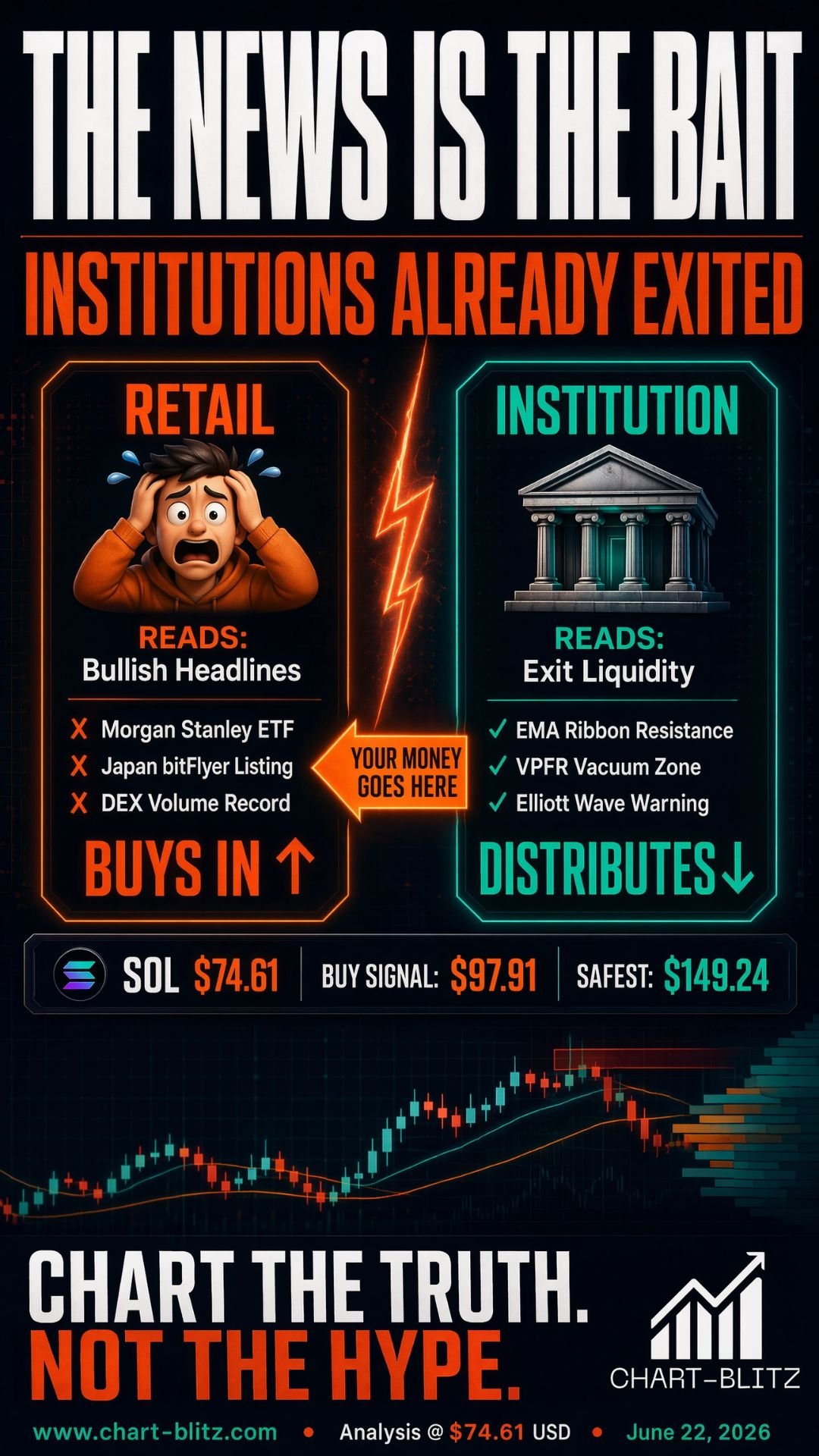
🌪️ News Flying High: Retail Sees Opportunity, Institutions See Liquidity
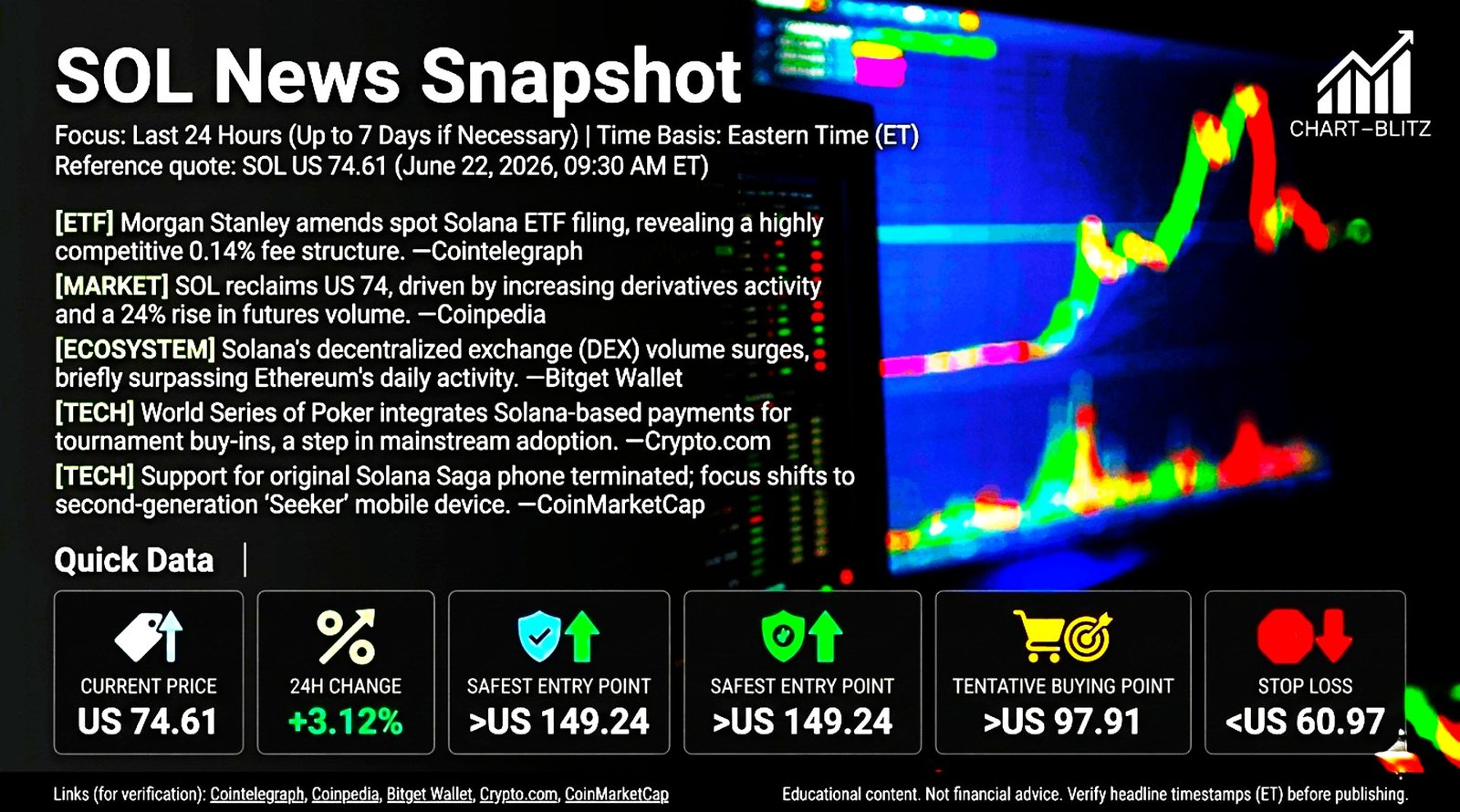
Over the past 24 hours, Solana (SOL) news has dominated the headlines. Morgan Stanley announced its application for a spot Solana ETF, proposing a globally competitive low fee of 0.14%, directly challenging all rivals in the space. Japan’s FSA-licensed exchange, bitFlyer, announced the listing of SOL on June 24, marking a significant breakthrough for Solana in Japan’s strictly regulated market. Furthermore, Solana’s DEX trading volume briefly surpassed that of Ethereum, making it the most active decentralized exchange ecosystem globally. Simultaneously, Bitcoin ETFs recorded six consecutive weeks of net outflows, while SOL funds continued to attract fresh capital, signaling a quiet rotation of market funds.
Following these announcements, retail trading groups exploded with FOMO (Fear Of Missing Out), with many believing “the good news is out, a massive rally is imminent.” Social media was flooded with “SOL To the Moon” calls. On the surface, these are indeed positive catalysts. However, as an ex-banker with 20 years of experience on the trading floor, I have seen this “good news paired with chart distribution” playbook play out far too many times.
Recall November 2021, when SOL surged to its all-time high of $254 amid a wave of bullish news, with headlines proclaiming “Solana is the Ethereum Killer.” Retail investors poured in. But at that very same moment, the weekly MACD had already displayed a clear bearish divergence at the top, and trading volume was beginning to contract. Institutions quietly completed their distribution while retail was at its most euphoric, and SOL subsequently plummeted from $254 all the way down to $9. This is the quintessential case study of “bullish news = institutional Exit Liquidity.”
Think about it: if the news is genuinely that bullish, why is the price still struggling to hold above key resistance levels? If large players truly want to push the price up, why isn’t the trading volume supporting the move? What retail investors see is news; what institutions see is liquidity. Whales love it when retail is overly optimistic, using these “good news” events to create Exit Liquidity, slowly offloading their holdings to unsuspecting retail buyers.
The real answers are never found in news headlines; they are hidden within the intricate details of the candlestick charts. News only provides the “subject of analysis,” but only rigorous technical analysis can predict the “timing” and “manner” of future market movements. Today, we will filter out the noise of the news and look directly at the charts to see what the market makers are truly plotting.
【📊Analysis Baseline Statement】
All technical analysis below is based on the price snapshot locked on June 22, 2026 (EST 09:30): SOL = 74.61 USD. Please treat this report as an “analysis map” rather than real-time quotes..
📈Weekly Chart: The Life-or-Death Watershed
The weekly chart is the soul of all analysis. If you only focus on the short term, it’s like navigating a maze with a magnifying glass—you will never see the big picture. On the trading floor, there was an unwritten rule: “Never fight the weekly trend.” This was a lesson learned through countless losses.
Weekly Timeframe for SOL (Solana)
1. The Iron Rule Test of Elliott Wave Theory
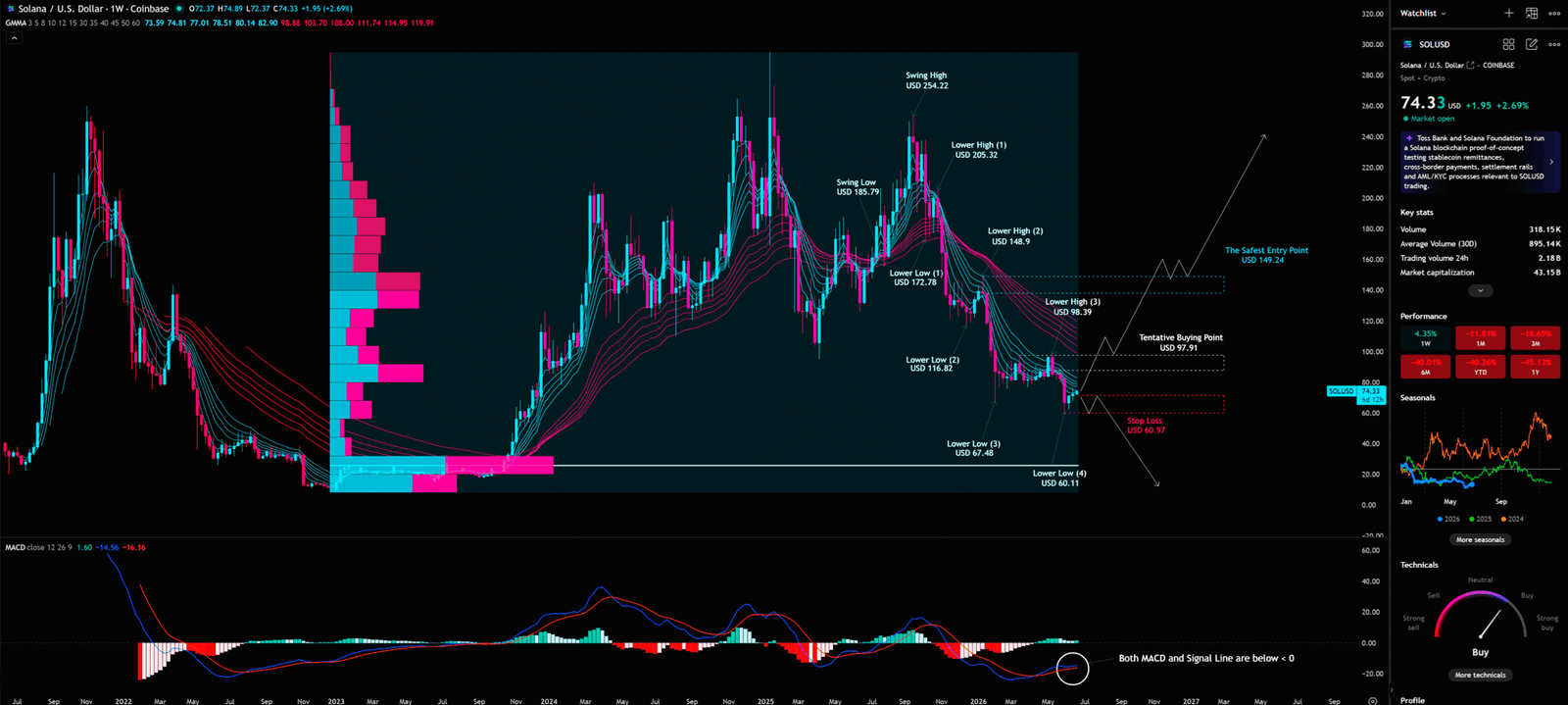
As seen on the weekly chart, SOL previously experienced a clear 1-2-3-4-5 upward impulse wave, rallying from the lows of late 2022 all the way to the Swing High of $254.22 in late 2024. However, the current price action is situated at a highly sensitive juncture.
The chart clearly marks a series of Lower Highs (LH) and Lower Lows (LL), forming a distinct descending channel: Lower High (1) $205.32 → Lower High (2) $148.90 → Lower High (3) $98.39; Lower Low (1) $172.78 → Lower Low (2) $116.82 → Lower Low (3) $67.48 → Lower Low (4) $60.11. This “lower highs, lower lows” structure is a textbook descending trend.
At this moment, we must remember an iron rule of Elliott Wave Theory: The bottom of Wave 4 must never overlap with the top of Wave 1. If the price of SOL continues to decline and breaks below the top of the previous Wave 1 (the critical defense line), the entire assumption of the 1-2-3-4-5 upward impulse wave will be completely invalidated. In that case, this decline is not merely a correction but likely part of a larger degree A-B-C corrective wave, implying a deeper and more prolonged downturn.
Therefore, one must never prematurely conclude that a certain drop marks the “bottom of Wave 4.” Retail investors love to catch falling knives at these levels, often with disastrous results. Could the most dangerous moment in the market be precisely when everyone believes it’s safe?
2. VPFR Vacuum Zone and the Market Maker Trap
Let’s look at the Volume Profile Fixed Range (VPFR) indicator on the left side of the chart. VPFR is one of the most utilized tools by institutional traders, revealing which price levels have the highest concentration of trading volume, thereby identifying genuine support and “vacuum zones.”
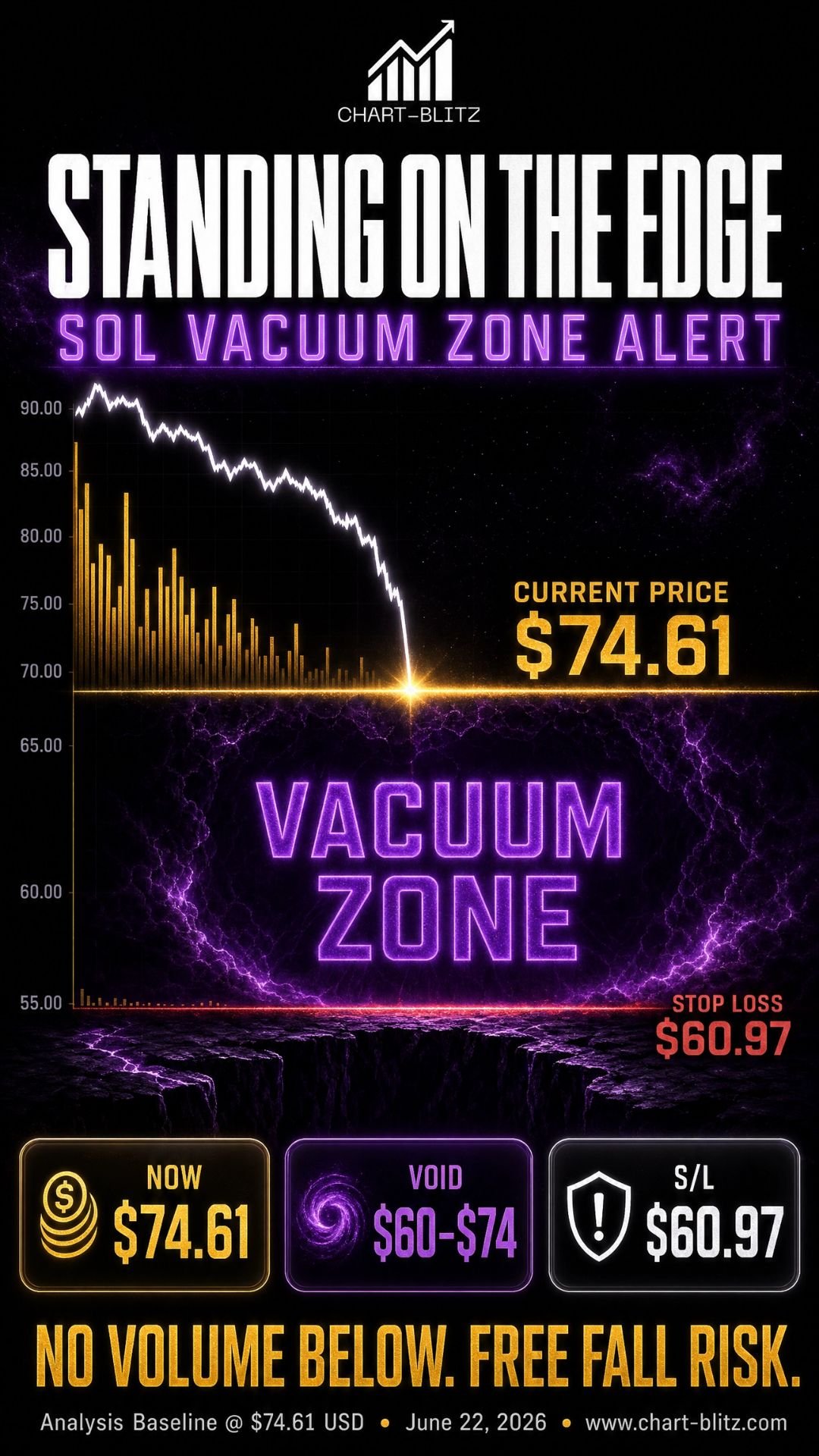
VPFR differs from standard time-based volume; it displays volume distribution across “specific price ranges.” On the SOL weekly chart, you can clearly see that in the $60 to $75 range, the volume histogram is exceptionally short. This is known as a “Vacuum Zone.” Within a vacuum zone, due to a lack of sufficient buying support, once the price breaks below the upper POC (Point of Control, the price level with the highest volume), the descent can be extremely rapid, akin to a free fall.
Coupled with the aforementioned news, it is highly probable that whales are utilizing these bullish catalysts to generate liquidity and distribute their holdings at elevated levels. Once the distribution is complete, the price will naturally slide into this vacuum zone, triggering a cascade of stop-loss orders and inciting panic selling. This highlights the profound information asymmetry between retail and institutions: retail buys based on news, while institutions sell based on VPFR. If large players truly want to push the price up, why isn’t the trading volume supporting the move?
3. The Entry Logic of S/R Flip (Support/Resistance Interchange)
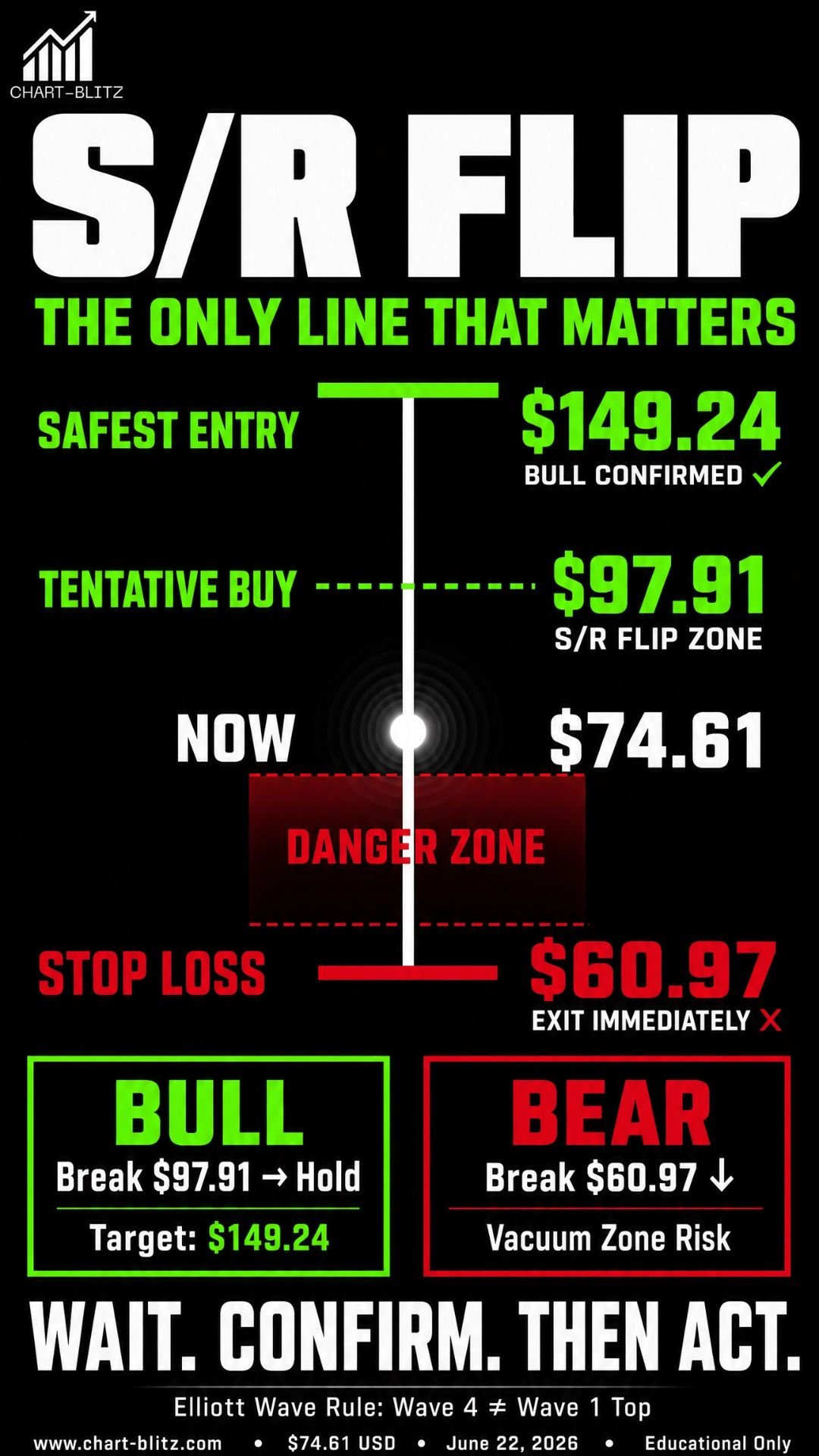
The chart clearly indicates several critical price levels, personally annotated by the analyst—these are the skeleton of the entire analysis:
| Key Level | Price | Significance |
| The Safest Entry Point | > $149.24 | Break and hold confirms bull market return |
| Tentative Buying Point | > $97.91 | S/R Flip triggered, tentative entry |
| Current Price | $74.61 | Analysis baseline |
| Stop Loss | < $60.97 | Break below = exit immediately, no exceptions |
This brings us to a core trading logic: The S/R Flip (Support and Resistance Interchange Rule).
Theoretically, the SOL downtrend should not be over yet, but if the SOL price does not continue to fall but instead turns upwards and explodes, it needs to be seen whether it can rise to the resistance zone. If it breaks above and holds, then enter the market; otherwise, it will reach the stop loss and sell off.
If the price can break through and stabilize above $97.91 (Tentative Buying Point), this former resistance level will transform into a new support level (S/R Flip). At this point, a small, tentative buy can be considered. However, true confirmation of a trend reversal requires the price to break through and hold above $149.24 (The Safest Entry Point). This is the moment for a more substantial commitment. Conversely, if the price drops below $60.97 (Stop Loss), it signifies a complete collapse of the defense line, and one must exit decisively without hesitation.
📊Daily Chart: The Gravity of Fibonacci and the Suppression of EMA
Having assessed the macro picture on the weekly chart, let’s narrow our focus to the daily chart. The daily chart helps us pinpoint short-term support and resistance with greater precision.
Daily Timeframe for